
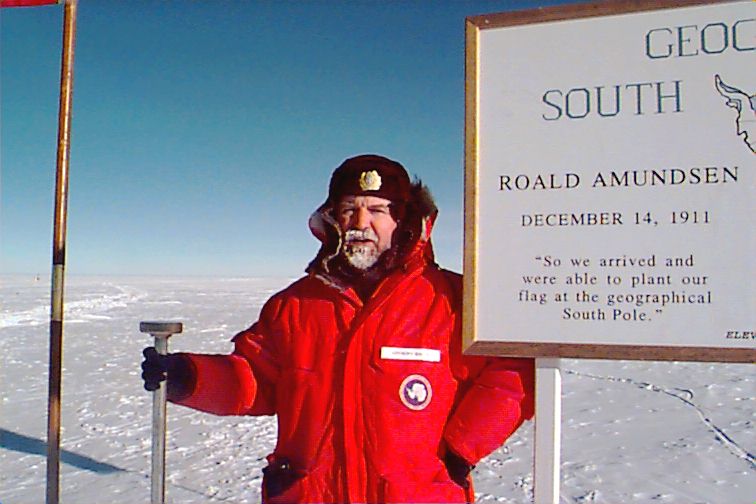
Journal Entry:
Christchurch, New Zealand
Tuesday Jan. 28
I packed all my equipment into 4 big boxes. Each had to be clearly labeled “Do Not Freeze”, and painted black. There are several categories of freight and equipment for shipment to Antarctica, according to whether they have to be kept in heated warehouses (most scientific equipment does not want to freeze); whether they can be left outside to freeze in the cold (bulk materials, construction supplies etc.) or whether they do in fact HAVE to be kept frozen – such as returning scientific samples of biological material, or ice cores drilled from deep down to study conditions in Antarctica many thousands of years ago. The “Do Not Freeze” category is painted black for identification – so I will go to Oakland airport with 4 ominous black boxes. It would be scarcely more threatening if each were labeled “Bomb – Do Not Drop”. But they checked me in, no problem.

Our cat came and sat on the computer keyboard for the last time. It will be hard to work without this kind of supervision: pets are not allowed in Antarctica so I don’t expect to see a cat for almost a month! (Note: just as there are Protestants and Catholics, PC and Mac people, Serbs and Croats, early-morning and late-night people, there are also Cat people and Dog people.)

The flight from Oakland to Los Angeles was delayed, and packed full: two flights combined into one. Rush through LAX, get to the departing gate for the flight to New Zealand just in time. It too was delayed and double-packed: a crowd of bewildered Australians was wondering how they were going to get home. Finally we are all wedged onto the 747 like cordwood. 16-inch centers are fine for 2×4 wall studs but not for breathing room on a 13-hour flight. I had a window seat – the only salvation. But next to me was a giant of a man: his hairy arms sticking out of his short-sleeve shirt were bigger than my legs; his collar size would probably be loose on my son’s waist. Once he wedged himself into his seat, he was clearly immovable: his stomach bulging out from his untucked shirt almost touched the seat in front.
” Jaizus Croist” he said, and then pried of his shoes, one foot with the other. I was very glad when the ventilation air came on. His wife, Mrs. Big Bird, sat in the aisle seat. I hoped that I wouldn’t have to try to get up and go to the bathroom in the next 13 hours.
The plane departed at about 10 PM, so after dinner it was night. Fortunately, I managed to sleep. Breakfast posed an interpretive challenge for my seat neighbors. The United Airlines leaflet offered the following New Age esquisitos:
1. “Chow Mein Crepes, filled with barbecue chicken, sliced mushrooms, bell peppers and carrots, tossed with angel hair pasta and sesame seeds”
2. “Fluffy Soufflé, baked with apples and walnuts, complemented by a vanilla sauce”.
“Wodja gen airve?” asked Mrs. Big Bird
“Gor” was all Mr. Big could say, until I asked for crepes.
“Sime azim” said Mrs. Big Bird
“Air” said Mr. Big
Last Cultural Note: Tea and coffee were served on the plane, as usual: however, the flight attendants asked if you wanted Milk, rather than Cream as is the usual question on U.S. flights – even though in fact it is neither. They have probably learned that Australians prefer fewer rather than more subtleties.
I am carrying a barometric altimeter, which measures the absolute pressure and interprets it as an equivalent altitude. Years ago, one’s ears would always ‘pop’ on a flight, due to rapid changes in cabin pressure. Nowadays, the cabin pressure is programmed for a very gradual change, to avoid ear discomfort. The cabin pressure is less than sea level, but of course does not relate to the actual altitude of the aircraft. I took readings of the cabin pressure ‘altitude’ after take-off: it changed from 0 feet to 4200 feet very smoothly over a period of 30 minutes. When I awoke, the pressure had been further reduced to an equivalent altitude of 6000 feet: I have heard that they reduce the pressure on night flights to induce the passengers to sleep, thereby placing less demands on the crew.

I awoke at about sunrise: we were flying through a luminous pink mist, somewhere over the central Pacific Ocean. I don’t expect that the picture came out.
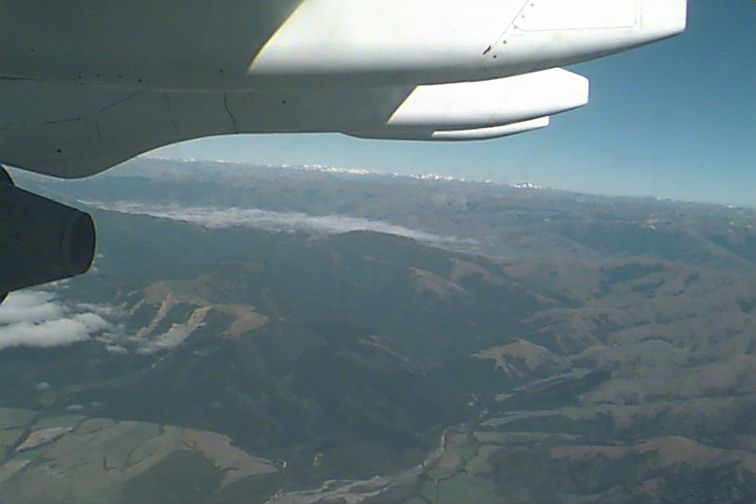
We landed at Auckland in the early morning (there are plenty of stories of little old ladies confusing Auckland with Oakland and having a surprisingly long flight). It was green and lush, almost tropical, though from the air the small fields and rolling hills looked like England. My luggage arrived safely, and I checked through NZ Customs with just enough time to run from one terminal to the other for the connecting flight to Christchurch. Hurrah for the invention of the wheeled trolley. The next flight was just over an hour; approaching Christchurch we had a great view of the snow-capped mountains of the South Island. The countryside here looks more like California: dry and somewhat brown at the end of summer. The U.S. Antarctic Program local manager met me: I am to report back at 2 PM this afternoon for clothing issue, and I depart for The Ice tomorrow morning at 6 AM. What little I have seen of Christchurch looks exactly like a small English town with the vegetation of California. I shall try to send this dispatch with pix from the USAP this afternoon: my next message will be from McMurdo!

Journal Entry:
Christchurch, New Zealand
Tuesday Jan. 28
Went out to the airport where the Antarctic Operations base is. Checked in with them and went to the Clothing Distribution Center. Everyone is issued with two bags full of complete Extreme Cold Weather gear – from long underwear right through to the parka and wind trousers. Their premise is to assume that we didn’t bring *anything* with us in terms of cold-weather clothing. So I signed out for a full set and tried it on for size. I had previously filled out a form with my clothing sizes, so it was all correct right from the start – a very efficient operation. The CDC is like a giant warehouse: in the back is a storage room with rows of parkas on hangers as far as the eye could see. At times they process as many as a hundred people at a time: today, it was just me. It was a little odd, almost as if this well-oiled operation was there just for me. But more odd was the lack of any buddies to comment to .. “How do I look?” … “You put it on backwards” … prompting the philosophical question: Is an adventure realized if it is not shared? Perhaps that is why I wanted to write this on-line journal, and (hopefully) interact with correspondents, lest I simply depart and then return three weeks later … “Did you have a nice trip? now get back to the routine where you left off”.

One bag contains the clothing that I MUST wear when boarding the plane: a full set of Antarctic-rated gear. Everyone has change before departure and then get on board in their parkas and bunny-boots, with their ‘civvies’ (civilian clothing) replaced into that bag. The rationale is that if the plane has to make a forced landing on an ice floe, you better all be dressed right: no rummaging around in bags when evacuating. So I shall trudge across the tarmac in 70-degree temperatures, wearing clothing rated for 50 below. I had not expected to worry about heat exhaustion on this trip.
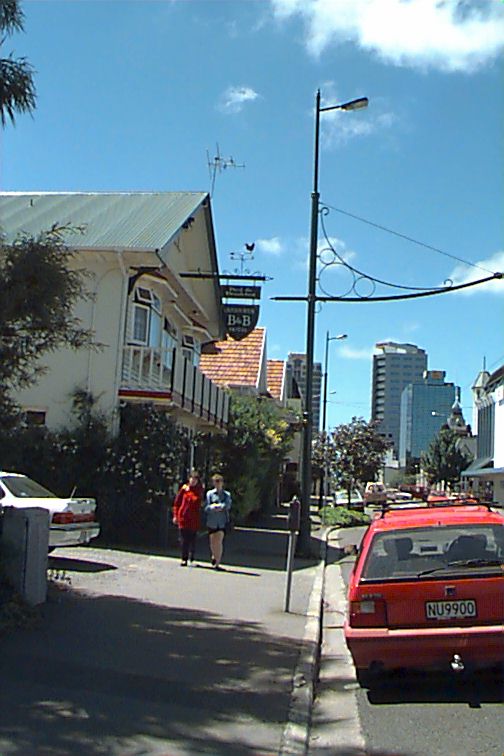
Thence to the NSF Operations Center, where I logged in to e-mail and transmitted my first report + pictures. Yes, it is amazing, I am actually in New Zealand, but I simply type ‘Telnet’ or ‘Mail’ and it is as if I was in my own office. Al Gore was right, and Bill Gates is rich, exactly for these reasons. I’m here, I’m anywhere else, it doesn’t matter any more. I hope the stuff gets received OK, Tod I appreciate all your efforts. I zipped 7 pictures into a 600-K file and it transmitted pretty quickly.
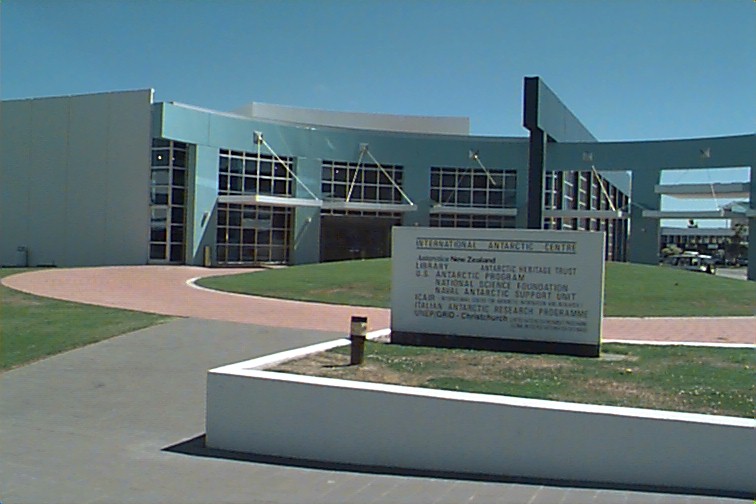
Thence to the Antarctic Centre (note spelling – it’s a local organization). This is a tourist attraction at the Christchurch airport, with gift shop, dioramas, and a surround-vision theater. I bought postcards, as I was forewarned that by the end of the season the stocks may be depleted at the station stores on the ice. This evening I will stick address labels on them all and U.S. stamps, so that I can get everyone’s card imprinted from the post office desk at the South Pole. It is absurd, that I buy postcards in New Zealand, stick US stamps onto them that I brought from the States, carry them all the way to the South Pole, get the stamps canceled and the cards get put into a sack, so they can be brought back to NZ, and thence via the USAP back to the States, and then mailed to you. Is this a great effort on my part? – yes, but it is atonement for not sending any Christmas cards this year.
***GOOD NEWS***
My departure tomorrow morning just got re-scheduled: 9 AM pickup at the hotel, instead of 6 AM. Hurrah for the military, I can have breakfast.
Journal Entry:
In the air on the way to Antarctica
Wednesday Jan. 29
I am writing this on board the C-130 aircraft, half an hour after departure from Christchurch on an eight-hour flight. The departure was delayed from 9 AM to noon due to bad weather at McMurdo. The muster officer told us that it will be -20 degrees C with fairly strong winds and blowing snow. “Summer’s over”, he announced.
I had a Good English Breakfast at the guest house before checking out – two fried eggs on soggy toast with baked beans and three “bangers” .. items that are not allowed to be called “sausages” in the U.S., where that word refers to a food item containing only meat-derived products. The British Banger contains a trace of meat so that it can be thus described, but is then back-filled with sawdust, road sweepings and finely ground garden debris. When fried to perfection and liberally doused with A-1 sauce, just one will be enough. Needless to say, I ate the lot, washed it down with several cups of tea and checked out.
At the USAP center, I took off my ‘civvies’ and put on my issued cold weather gear. It was at least 70 degrees F outside with a bright sun in a clear blue sky. Then they announced the 3-hour delay. I didn’t expect that heat prostration would be a hazard of this mission. We waited in the departure area – just three scientists, but a couple of dozen young military personnnel (U.S. Navy and N.Z. Forces, men and women) who are going down for a couple of weeks to unload the cargo ships that have just docked. They will unload the winter-over supplies (food, fuel) and reload with ‘retro cargo’ , much of which is recovered waste, recycling etc. The law is very strict about not leaving any garbage there any more. They were a noisy, lively bunch in the departure area.

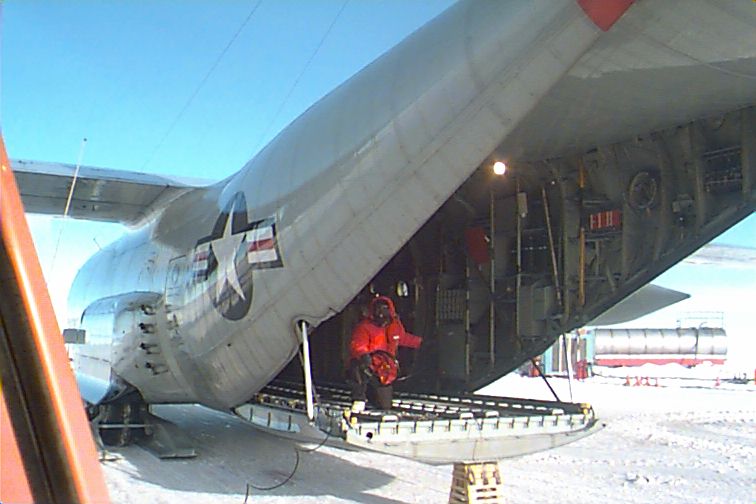
Finally, we get the word. We line up, and our baggage is sniffed by the Drug Dog. Clump out onto the bus in Antarctic clothing under a burning hot sun: drive over to the tarmac where the plane is almost loaded. Inside, the plane is more ‘industrial’ than other projects I’ve flown on – even in Russia. The interior is a mass of pipes, wires and the exposed inner workings of an aircraft. “Earplugs?” they call out. We all raise our hands.
There’s something about the sound of a turboprop plane exercising its blade pitch – from forward to reverse thrust as they do just before take-off – that is an indelible memory of projects such as this. Just that sound alone is enough to make me think of hundreds of hours in the Arctic.
Inside the plane, we sit in sling webbing seats along the sides. The center is piled with bags and bundles and boxes. After take-off, people lie down on the metal floor, padding themselves with their wadded parkas to smooth out the cargo runners. There are only a few small portholes, and nothing to look at anyway: we will be flying over ocean all the way. Surprisingly, the cabin pressure is kept almost at sea level, though we are of course flying at about 25000 feet. It’s not that warm in the plane, but I’d better start getting used to that.

The “Rest Facility” on this plane is slightly more advanced than the literal bucket on the Antonov-26 out of Cherskiy .. except for a characteristically-military design flaw. Behind an olive-drab curtain, on one side of the plane there is a funnel attached to a tube. Should work OK? .. if only (1) the funnel was a foot lower … and (2) not buried deep amidst a mass of pipes, tubes and wires. If it were the Blarney stone, you *could* reach it: but for the intended purpose, its use would be difficult under any circumstances, let alone if you are wearing long underwear and bib-front padded coveralls. Thank goodness that most aircraft systems are hydaulic rather than electrical, I would hate to cause a short.

For a while the interior of the plane is much too hot: next, it is much too cold. Somewhere up front there is a Knob. I went up to the cockpit, took a couple of pix: it’s quite spacious up there, with the pilot and co-pilot up front; the flight engineer sitting behind them; the radio man on one side; and the navigator at a little table with his charts. Surprisingly, it seemed as noisy and vibrating in the cockpit as it does in the main body of the plane. This plane is *really noisy* – and everything vibrates. I feel sure that if you put a cup of water on the metal floor, it would buzz in waves.


My thermo-hygrometer says 71 degrees F and 26% relative humidity. I don’t believe the temperature.
We are now 3 hours in to the flight, not yet half way. I looked out of the window – just ocean with whitecap waves. The flight briefing had warned us of turbulence half way down: perhaps we’ll have to strap down. In severe turbulence, being in this plane would *really* be like being shaken in a bean can.
At 4:45 pm (3 1/2 hours), someone says they just saw the first ice floating in the ocean. Soon they said we will cross the Point of No Return – the distance beyond which the plane has used more than half its fuel, and *must* therefore proceed – if it turned around, it would not be able to get back to Christchurch. This seems too soon if it’s an 8-hour flight: surely the plane will not land empty, but will have *some* reserve for headwinds, circling etc. I would have expected it to carry 10 hours’ of fuel, making the PNR five hours of flying. I’ll ask.
The loadmaster says “No turbulence today. Too bad, eh?”
The co-pilot is a woman, and there are maybe seven out of 30 passengers who are women. They are dressed in military cold weather gear identical to the men, and look as capable as any of their colleagues. It is good to see that women have comparable opportunities for these kinds of challenging assignments – I guess that has been one of the great equalizers of the modern military. That certainly wasn’t the case in Russia.
6:30 pm 5 1/2 hours of flight: 2 1/2 more to go.
What a curious form of purgatory this is. Too noisy to think, way too noisy to speak to anyone except by yelling though their earplugs and gesticulating. Certainly no conversations. Too dimly lit inside to read, too bright outside to see anything: but in any case there are only clouds, waves and water. From the dim recess of the plane’s interior the portholes are like halogen bulbs, almost painful to look at with dark-adapted eyes. People lay back, some dozing, buried under parkas and layers of gear. Some lay on the floor, on their gear. Some wander listlessly back and forth, stepping over the slumbering masses of padding and boots like an obstacle course. It alternately blows hot then cold. Four men are squatting on the floor, playing cards: but in the din they can not easily call their bets or coax their partners. From time to time a flight crew member comes down and around, agile in his one-piece non-bulky flying suit: he surveys the cargo, human and otherwise, then returns back up the ladder to his higher plane. (pun 🙂 ). In one Web journal that I read, a student was astounded that anyone could simply lie back and try to sleep on this flight: she was so excited at the prospect of going to Antarctica. Unless you have brought a long, easy book and are sitting near a window for light, there really isn’t anything else that you *can* do. I can guess that this is what an emigrant’s passage was like: a journey of great significance, totally overwhelmed by the mechanical aspects of the travel. These young guys are going to be *really* ready for a beer when they deplane.

7:45 PM – probably less than an hour to go. Suddenly, a transformation. Perhaps induced by as simple an action as turning down the heat in the cabin. Or maybe the sight of ice on the ocean and perhaps even a mountain in the distance – Mt. Erebus? But in any case, the aircrew come through one at a time and pull on warm suits over their flying gear: the passengers pull on additional layers and are now huddled under their parkas. It’s as if we’re arriving – even though it may be a while yet. Certainly a good idea to start “thinking cold” rather than having the heat on high until the doors pop open at McMurdo. The first time we landed at Thule Air Base in Greenland (AGASP-1, 1983), none of us had been in real cold before – nor the aircrew, who were based in Miami! I remember the look of horror on Capt. Turner’s face, as he wanted to make a good impression on his hosts and got ready to be the first out of the opening door from a nice warm plane, in his tropical-white NOAA Corps uniform. He almost hurled himself back into the plane, gasping for breath, hitting a wall of air at 45 degrees below zero.

I don’t know what to expect upon arriving – may not be able to write for a while.
Journal Entry:
McMurdo
Thursday Jan. 30

First day at McMurdo. What a fantastic place! Although we were dressed for the worst when landing in the plane, the doors opened to reveal incredible scenery under bright sun and cloudless blue sky. I could not imagine a more beautiful scene in the Rockies. We landed at 10 PM (on the 29th), but the sun was high and bright. The planes land at “Willy Field”, which is on the permanent ice of the Ross Ice Shelf, over from the East side of Ross Island on whose western side is located McMurdo. Smooth landing, doors open, and it WASN’T COLD. Clamber onto the ‘Terra’ bus, a huge vehicle riding on giant fat tires. The ride back to McMurdo took about 20 minutes: the climb up onto the black volcanic dirt of Ross Island was a real contrast from the first few miles across the perfectly flat, white snow cover of the ice shelf. We disembark: I am assigned to a room in the so-called “Mammoth Mountain Inn”; on one side is another accommodation building, called the “Hotel California”; on the other side are the NSF Headquarters building and beyond that the Crary Lab, a complex of brand-new laboratories and offices.

From my window I am looking west: right underneath is the helicopter pad area, beyond that is the McMurdo Sound with patches of open water and then the Trans-Antarctic Mountains in the distance.

It’s 36 degrees F outside with bright sun at midnight .. time to go to the canteen for ‘MidRats’ i.e. midnight rations. The canteen looks like any U.S. institutional cafeteria – trays, self-service hot and cold food, tabasco sauce on the tables. (but the food isn’t Quite as good as at LBL). I’m hungry – didn’t really eat since breakfast. Walked around – the place is deserted despite the brightness, because it’s *actually* 1 AM. Took some pix and fell asleep quickly.
****I’ll have little time to write – I have to prepare for departure to the Pole !!! SOON !!!
So what happened today?
In a nutshell:
Woke 9 AM, good sleep
Next door is the NSF office. They know all about me and are waiting!
Next door to that is the Crary Lab. Words can not describe how modern, well-equipped, and the VIEW!!!! Agh!! even better than the view from LBL, over the San Francisco Bay with the Golden Gate Bridge. !!! Yes !! This is the place where you have died and gone to heaven, at least on days as crystal-clear as today. Across the frozen sound are ranges of the most incredible mountains, through ALL the windows!
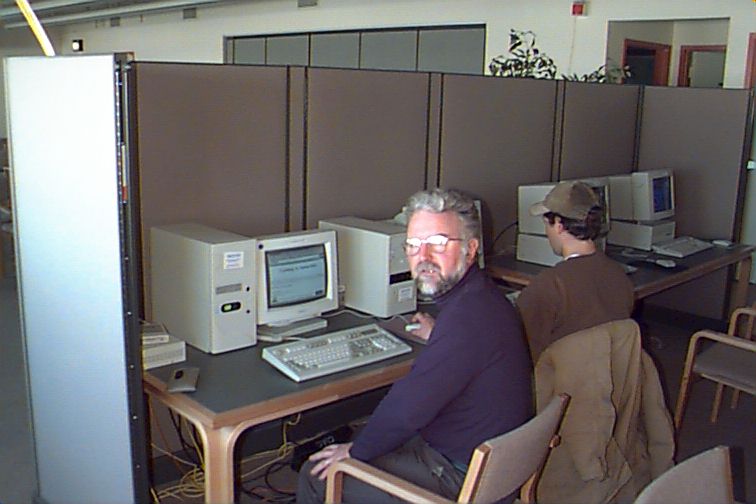
Upstairs, a computer room. I log in to Netscape – there’s my Web page!
They show me to my office. MY OFFICE ??? Of course, all science projects get an office.
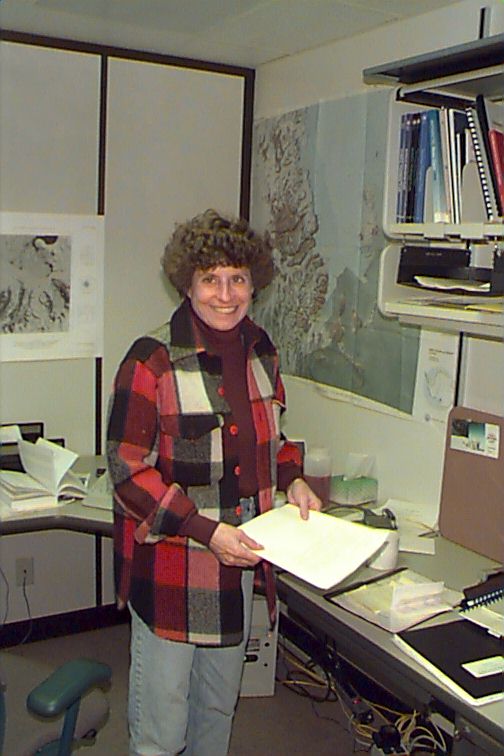
Down the hall is Dr. Jane Dionne, the NSF Manager under whose program I am here. We talk – she’s excited. I show her the Web page – she’s VERY excited. I explain the educational context. “Tony”, she says, “we’ve got to discuss this with the NSF Head Scientist who is at Pole, I’m going there in a couple of days, we’ll all talk. This kind of live-from-the-field science is great.” I take her picture. “Jane”, I say, “you’ll be on the Web tomorrow”. and then the pitch … “and with this kind of reporting, your projects can be on every Congressman’s staffer’s desk too .. live science, taxpayers’ dollars at work”.
We will talk more about it, but the impact is really there.
Lunch in the galley – good, and lots of it. Back to the Lab for, then repack some of my stuff so I don’t haul everything to the Pole, not some things that I know I won’t need there.

GREAT OPPORTUNITY – the Coast Guard icebreaker is tied up at the pier. It has been making a channel for the cargo ship that will come in on Monday. They have announced a ‘recreational cruise’ for a few hours this evening. Board at 6, return at 10. Great – it should be fun.
Go to the galley at 5:30, check Flight Board before going in. Chow, prepare to leave and walk down to the pier.
JUST TO BE SURE, check Flight Board again on way out. YIKES !!! – I am on the first flight out tomorrow !! – and ‘bag drag’ is due at 8 PM tonight! (‘bag drag’ means checking in with all your stuff so they can weigh you to determine the plane load.) But if bag drag is at 8 PM, I’ll miss the icebreaker cruise. Boo and Double-Boo. I call : “bring your bags now”, they say, “we’ll weigh them in advance”. But it’s 5:50. “Hurry” they say.
Hurry ???? let’s call it aerobics. Run back to dorm, stuff all bags: 4 of them, total weight probably a hundred pounds (include all ECW’s = Extreme Cold Weather gear). STAGGER back to flight center, quarter of a mile. Heart rate increases 400 percent. Sweat profusely, almost expire. Stagger in. “Don’t expire yet” they say “we’ve got to weigh you”. –
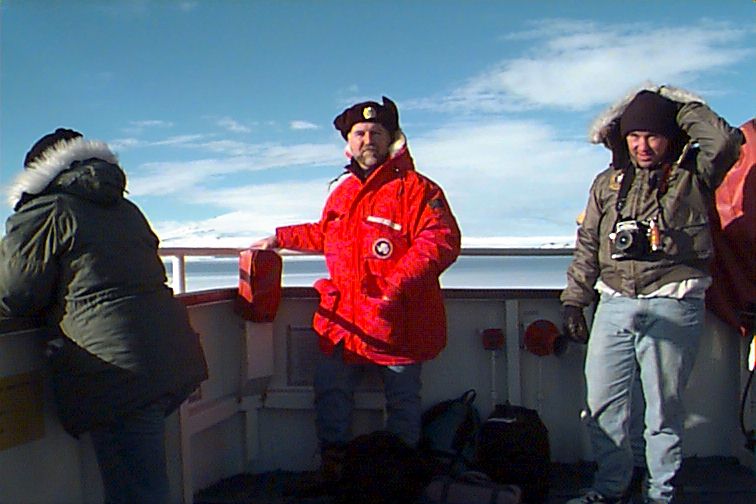

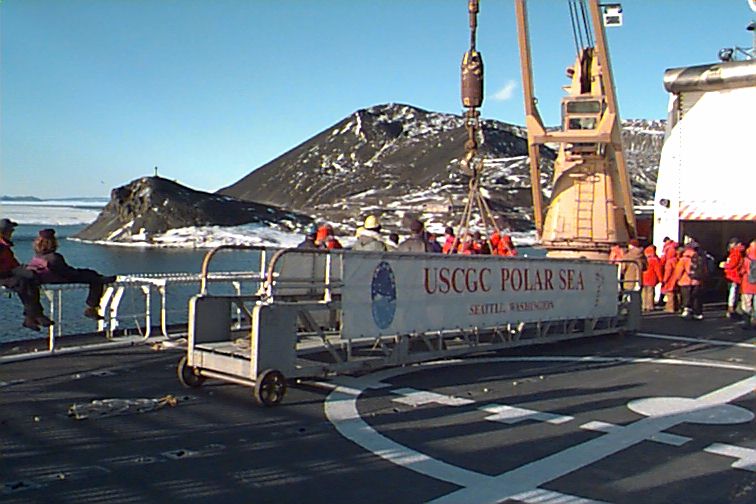
“Now run down to the pier and you might catch the boat” – I did catch the boat. It was WONDERFUL. It was worth every minute of rushing. After half an hour my heart rate had subsided and the sweat throughout my long clothing had evaporated in the dry air. The cruise was spectacular, I hope the pix came out.

And now, I’m back in my room – it’s almost midnight. I’ll finish this report, go over to the lab to e-mail it and then try to sleep.
MY ALARM CLOCK BETTER WORK !!!!! 5:45 alarm clock. 6:30 check in, fully dressed in ECW’s and ready to go.
I _ AM _ ON _ MY _ TO _ THE _ SOUTH _ POLE!
Journal Entry:
En Route to South Pole
Friday Jan. 31
I am on the aircraft on my way to the Pole.
My alarm clock didn’t fail me, I was up at 5:30 in an instant, quick cup of tea and dress in ECW’s.
Walk up to the MCC building, a clear sunny morning, blue skies and the mountains in the distance. It looks EXACTLY like a few hours ago, when I returned from the lab after sending yesterday’s material. Same sun, just in a different quadrant of the sky. Same lack of activity on base as at midnight, same complete quiet. It is eerie, as if the whole place is a stage set for an adventure movie. “Day” and “night” are defined only by the clock and human activity.

A few people are gathering inside MCC around the coffee pot. Voices are low. Husband and wife are returning to Pole to prepare for winter-over: they are permanent Icers, but keep a place in Homer, Alaska. Someone told me that the U.S. non-military personnel (i.e. station operations, logistical and science support) are 40 percent women, with strong encouragement for married couples. It certainly makes sense, and makes the town more of a community, less of a rowdy Buck Camp.
The identification with Alaska suddenly triggers in my mind something that I should have realized earlier: the conditions here and the people are exactly like those we’ve met in Alaska. The friendly helpfulness, the lack of pretension that come from doing a good job in an isolated community in a potentially harsh environment. These people live in rip-stop nylon. They shower rarely. There is no room for a bad attitude, no room for selfishness.

So we get on the bus, to drive out to the airstrip. A second van meets us, and the bus fills with “Coasties” (Coast Guard service) who are on a “sleigh ride” to the Pole. That means that there is room on the flight to take a dozen tourists: they get a 3 1/2 hour shake-and-bake (yup, it’s hot again), then 30 to 45 minutes of sightseeing and pictures while the plane reloads, then back to McM and their ship. Other than them, the plane is almost empty – a few hardy souls, a few bags, but this is a “tanker flight” and the bulk of the load is additional fuel that will be pumped out into the Pole tanks for the winter.
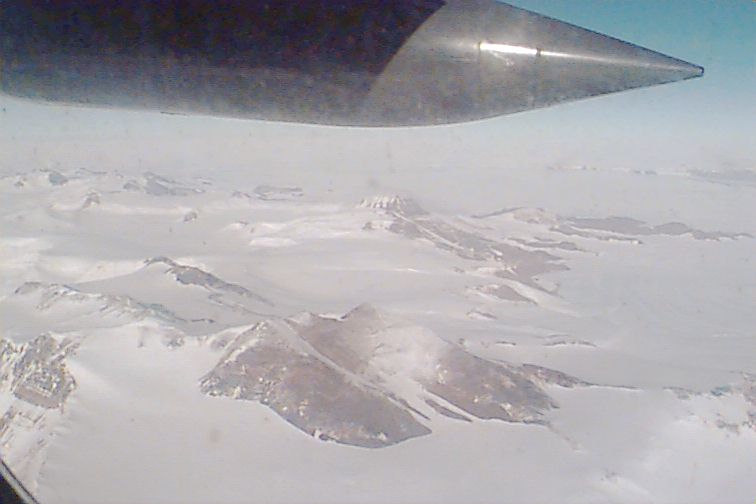
On board, the same. Din, sandwiches. But this time there’s a view, though the windows are rather scratched. I go up to the cockpit, fantastic view as we fly across the Trans-Antarctic Mountains, like flying over the Brooks Range during AGASPs. The aircrew are friendly and helpful. Looking out of the window, I ask the inevitable question: “Does this ever get boring?” They answer “after enough flights, yes.” I suppose one could ask that of us, of our attitude towards the inevitable view of the SF Bay and the Golden Gate Bridge from anywhere at LBL. Maybe not boring, but routine.
People loll and slumber, the plane drones on. My bag lunch included a peanut-butter-and-jelly sandwich on white bread, bologna-and-mayo on wheat, a snickers bar, some salted peanuts and a juice box. Now I know how Christopher feels every lunchtime at school.

10:25 AM They are starting to depressurize the plane to prepare us for landing. Barometric altitude at take-off was 900 feet (relative to Christchurch NZ set at zero). The pressure was a little lower at McMurdo than at ChCh. Now the plane pressure is 2500 feet and rising (i.e. pressure falling). The crew announce “Hundred miles out!”. We start putting our ECW’s back on – it’s minus 35 degrees C at Pole.
– – – – – – –
This message comes to you from the U.S. Amundsen-Scott South Pole Station.
Barometric altitude: 11,300 feet
Outside temperature: approx. -24 degrees F
Length of my shadow: 19 feet.
I made it.
I am at the South Pole.
Journal Entry:
At the South Pole
Saturday Feb. 1
Today I feel much better. I arrived at the Pole yesterday at about 11 AM. My excitement was tempered by the fact that I couldn’t breathe – somewhat of a fundamental consideration. The physiological altitude here is about 10,300 feet. I would take a dozen steps and feel exhausted: I lay down on my bed and felt like falling asleep at any instant.
But here I am! I made it.


– The Geographic Pole is a pole in the snow with a USGS Survey Marker on top. It says, simply, “90 Degrees South”. Because the ice, upon 3 miles’ thickness of which we are standing, is slowly moving at the rate of about an inch per day, and also because the earth’s rotation has slight wobbles, the actual Geographic Pole is re-surveyed every year. The marker posts from one year to the next are some tens of yards apart.
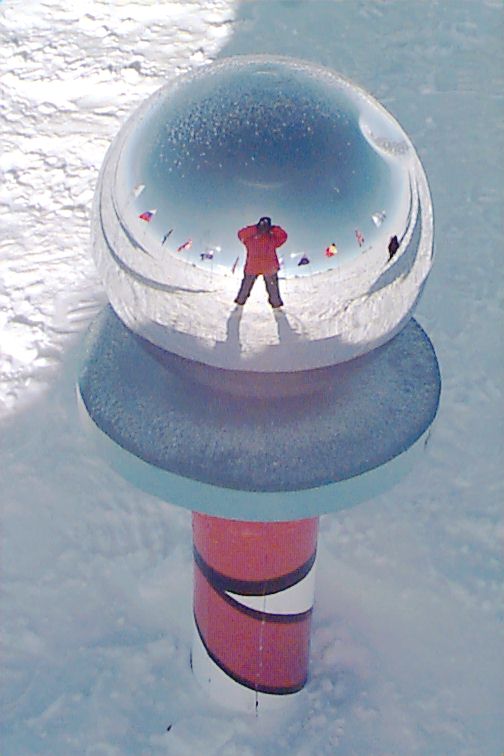
– The Ceremonial Pole is a candy-striped pole with a shiny ball on top. Not a Very Big Pole; nor a Very Big Ball. Understated, almost subtle. The pole sticks up from the snow maybe a couple of feet, and the ball is about a foot in diameter. In a semicircle around it are the flags of the various nations associated with the Antarctic. Thinking about it, it would be tacky if it were any bigger or gaudier. I wonder how big the Stone of Ka’aba is, inside Mecca? It doesn’t matter: it’s the symbolism.
And then we have the human artifacts that are assembled here, precisely because of the Pole: and for no other reason – we are in the midst of a vast, featureless identical sheet of ice. Why are we HERE, and not a hundred miles away? – precisely because of that symbolism. Our science would be equally valid a hundred miles away, but no dignitaries would come to have their pictures taken at a marker that said “One Hundred Miles to the South Pole”.

The human presence at Pole ( I have learned that one never calls it THE Pole, but simply ‘Pole’) takes on three main forms:

– the Dome with its side arches is now almost buried under the accumulated drift of decades of snow.

– the scattered science buildings stick up at various points, usually bristling with antennas.
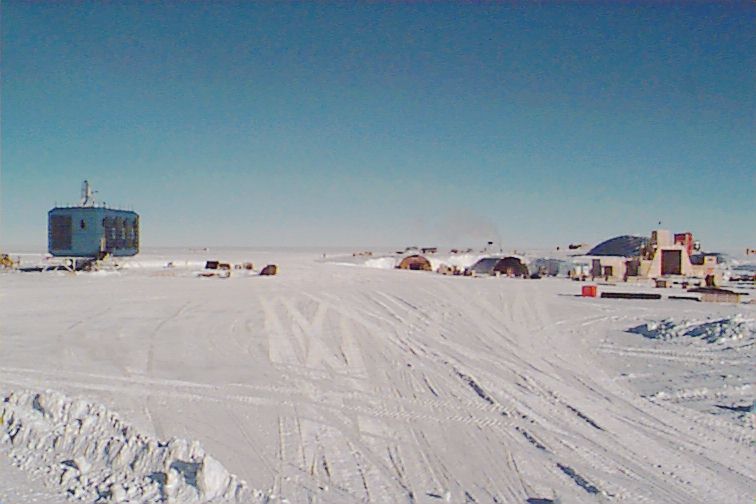
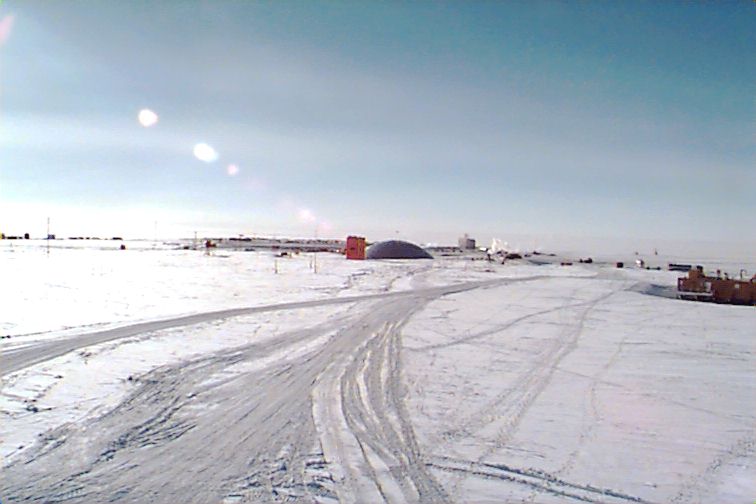
– but the most striking thing is the overall appearance of a construction camp. Huge bulldozers chug back and forth, dragging sleds with containers on them, dumpsters, whatever. Other bulldozers are shoveling snow: from where, to where, and why, I cannot tell. Yet other bulldozers slumber with a dieselly snore and white-mist breath of constantly-idling engines. Girders, beams, stacks of lumber, sheets of plywood are piled in orderly rows.

On the downside of the Dome, the Summer Camp is rows of tents (yes! – tents!! – but they are ‘Jamesways’ which are triple-insulated arched structures that look like giant brown sausages with doors at each end). Each Summer Camp unit has a sheet-metal chimney for the oil-fired heater: the chimneys steam in the cold air (no visible smoke as such) and from a distance one sees a mass of small buildings each with a cotton plume of white steam. The whole place looks like something that would have been set up for the construction of the Alaska Pipeline, which is probably the closest in similarity. Most of the men are dressed in brown insulated coveralls for outside work, liberally scuffed and stained, most of the women wear plaid shirts and jeans.

The place is also not that big, in terms of being able to walk from here to there and back again. On my first day, it was an eternity from the Dome to my room: now it is a 5-minute stroll. The snow squeaks and crunches underfoot, the sun shines relentlessly and it’s Another Beautiful Day. Every day.

Saturday afternoon.
——————-
I meet with the senior NSF Representative, Dr. Wayne Sukow. He is actually in NSF’s Education Program, and is interested in my ideas about having scientists send back pictures and reports that can be digested into educational material. I point out to him that the same pictures and reports, with their ‘cinema-verite’ quality, could also be packaged into press releases and polished up for distribution to Congress and other elected officials: Science In Action, Your Tax Dollars At Work. We will talk about this more when Dr. Jane Dionne comes up from McMurdo on Monday or Tuesday. I take a picture of Dr. Sukow in his office: I tell him, “When this comes up on the Web, your boss in his comfortable suite back at Headquarters will see you in a tiny office in an icebox”. He laughs, then says diplomatically “Take my picture while I’m still smiling”. I comply, and he returns immediately to his work, I’m sure he’s a busy man with all the big-name projects here.

Then I meet with Don Neff, the Science Coordinator. His job is to make sure that the scientific projects get the necessary logistical support from technicians, carpenters, electricians etc. His first question is: “So where is your equipment?”
Oops.
My four boxes DIDN’T come up on the plane: I had seen them at McMurdo in the cargo area, and had assumed that they had been sent up.
Wrong. They’re still there. And no more planes till Monday.
“Well that’s Mactown for you” says Don.
So we walk around to look at the two locations where they will be installed, to make necessary preparations. The New Clean Air Facility is a beautiful brand-new building, only just completed a few weeks ago and still being set up. It has 2 floors with lots of space, there will be no problem here. We go over to the downwind location. The requirement had been for a downwind building that would be powered and heated throughout the winter: many of the outbuildings are switched off and closed down once the summer season ends. The first suggestion had been the Well Building. It is a small shack containing two giant oil-fired boilers that inject boiling hot water down a 300-foot hose deep down into the ice, and suck up the melted water. This is the main water supply for the whole station. The problems were obvious: there was very little room amidst the pipes and tubes, there were two giant boilers that cycled on and off, making the temperature in the shack fluctuate up and down a LOT (bad for my instrument); and these two boilers were prodigious sources of smoke, right there. Not so good for installing a sensitive instrument for detecting pollution, in a boiler room!
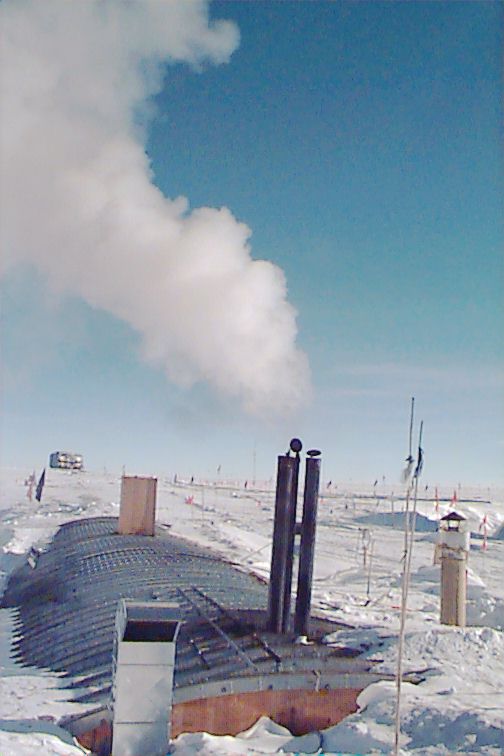
So we walk over to a brand-new structure that it not quite finished: the Balloon Launch Facility. This had not been mentioned at the time of my original proposal for the simple reason that it didn’t exist at that time. At first it was going to be unheated, but they decided to add a heated technician’s workroom to it, so it is perfect since it will be used year-round. The carpenters will put up a shelf for the aethalometer and the pump, and drill a hole through the wall for the sampling tube.
It’s interesting to see that with only minor changes, the construction methods, equipment and tools are (of course) identical to those back home. The carpenters make things out of 2×4’s, sheets of plywood, nails and drywall screws. Outer walls are cut from panels made from rigid foam insulation sandwiched between plywood, some kind of standardized product. The immediate vicinity of the finishing construction around Balloon Launch looks just like a construction site at home: tools, lumber, electrical conduit, boxes of nails …. except we are at the END OF THE EARTH, everything has come 10,000 miles by plane. Of course, there is no reason why it should be any different, these are the materials and techniques that these guys are familiar with. It just seems odd to see a box of Simpson Ties, made in San Leandro, here at the South Pole.
Saturday Evening
—————–
Party Time! .. everyone is invited out to the Old Clean Air building, now abandoned and slated for demolition. At 8:30 PM I walk in to a building full of talking, drinking of beer and loud music. All the equipment and fittings have been ripped out, some taken to New Clean Air: the walls are undergoing re-decoration by graffiti and (as the evening progresses) some of the more macho construction guys compete in events that could be described as Kick-Through-The-Wallboard-With-Your-Boots, also Rip-Out-The-Studs-With-Your-Bare-Hands, and other contests of strength and idiocy.
We talk. Some of the more grizzled, bearded Alaska types smoke cigars and pipes. The few scientists (referred to here as “Beakers”) look uncomfortable in the presence of their graduate students and the rowdy construction workers.
We dance. Everybody dances. A room full of gyrating people, loud music .. so far, a party anywhere. But we’re at the South Pole. Behind the tarps pushed up over the windows, the sun burns bright, too bright to look at. Outside, it’s 35 below zero, and this building never had a bathroom. The beer runs through you fast. The dancing people, myself included, are wearing bunny boots and insulated coveralls. I, for example, am wearing: underwear shorts; underwear longs; thick boot socks; bunny boots; underwear top t-shirt; underwear top longs; turtleneck shirt; denim shirt. My parka is hanging on a nail, together with my fleece jacket, hat, goggs and gloves. The floor is littered with beer cans. We dance, in 4 layers of clothing and insulated boots, at a physiological altitude of 10,350 feet. I gasp for breath every couple of dances, young guys in brown coveralls with stringy hair and Jesus beards give me another beer.
At midnight, it breaks up. We put on our gear and start trudging back. A snowmobile buzzes up, towing two aluminum sleds stenciled “CARGO”. The driver yells “Summer Camp?”. I and another guy get into the sleds, and we speed across the snow, weaving and bumping from side to side. Cargo indeed.
I haven’t danced for years. I’ve rarely danced in Arctic clothing. I’ve never danced at ten thousand feet altitude. I only got here yesterday. After a moment of reflection, I rationalize it as an aerobic exercise to increase my red blood cell count. I sleep well.
Journal Entry:
At the South Pole
Sunday Feb. 2
Slept well after the party, woke at a leisurely hour. Washed and shaved (first time for a long time), strolled over for Sunday Brunch. The food here is really very good: they are cooking for only a hundred-odd people, not a thousand as at McMurdo.
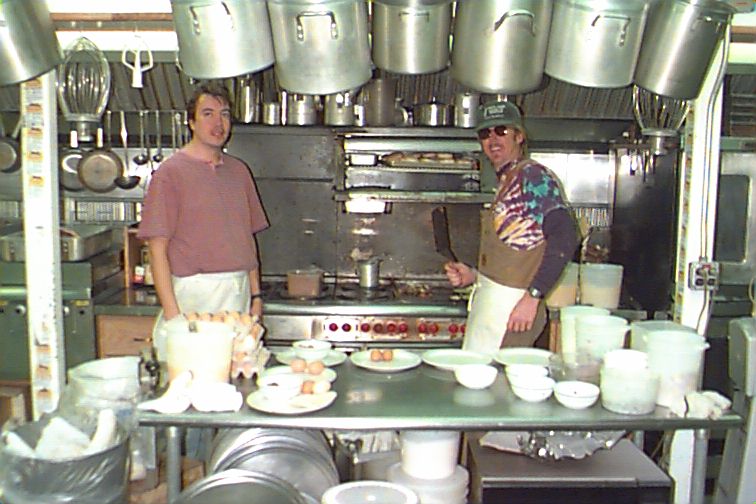

Since the inside of the Dome is unheated, it’s at -35 degrees: a nice freezer. All around the inside perimeter are boxes and boxes of food, perfectly frozen. ‘Bagels’ by the four-dozen-count, stacked almost as high as you can reach. Enough bagels to last for 8 months, indeed. And enough pork chops, and potatoes, and pastrami, and pineapple chunks, and peanut butter, and and and. A whole supermarket warehouse of food, *everything*, seemingly just piled outside the buildings, but the real weirdness is that the default condition of everything here is simple: FROZEN. There are no cockroaches here: in fact – no insects, no molds, no mildew, no weeds. No liquid water. Set something down, and it will remain preserved indefinitely in a frozen state. Those bagels could have been brought here in 1987, and they’d still be OK.


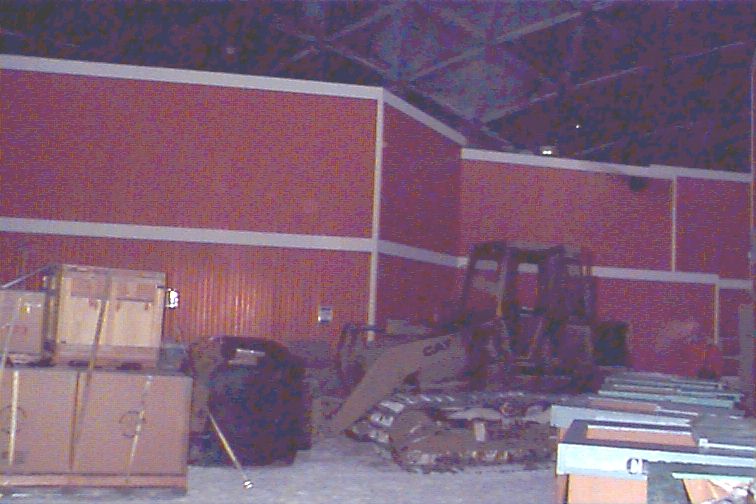


However, they do use refridgerators! I took this picture on my final day at Pole – a refrigerator was just delivered! I am astounded! – refrigerators at a place where the HIGHEST EVER temperature was +7 degrees F ???

I went to the computer center and finally figured out a way around the problems we’d been having with sending pictures. The e-mail system here won’t accept large files, so I sent each picture individually in a compressed form, rather than a whole bunch of them all at once. This makes for a lot more files, but if it’s what you gotta do .. you gotta do it. It is obvious that e-mail is a TREMENDOUS morale boost for the station personnel. The computer room is full of people, day and night: “beakers” and construction workers, all typing away. They stay in touch with their families and friends in a way not possible by written letters, and not really possible by telephone. There are a couple of periods every weekend when people can sign up for a phone call, but my understanding is that time is tightly rationed and the connection is not very reliable. E-mail, on the other hand, allows everyone to write their most profound thoughts, their tenderest emotions, with the knowledge that the message will get through before the day is out. Communications to the outside are only possible when the satellites are ‘visible’ over the horizon, which means three periods of a few hours each. The local computer network stores up all the messages, then transmits them out to the world when a satellite comes into view. ‘Back home’, one thinks of e-mail as an essentially white-collar activity: the manager, the scientist, the engineer, the secretary. The phone is universal, used by educated and uneducated alike. Here, e-mail is the universal link, and in the computer room I may be sitting next to a bulldozer operator in his hard-worn coveralls, carefully writing to his wife using his fingers in an unfamiliar mode.
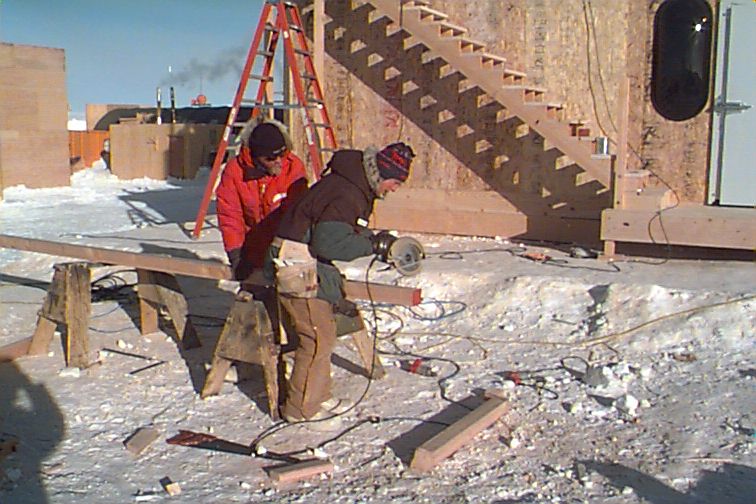
I then walked around to look at my sampling locations again. The whole site is suffused with the plumes from the myriad stacks of building heaters. The whole place steams gently in the harsh light. With the correct relative angle of the sun, I can see the cloud over the whole station, drifting downwind. It becomes clear that the Balloon Launch building will not get a sample that is representative of the whole ensemble of sources: it’s in the middle of it all, rather than at the farther edge. I talk to Don Neff, but he tells me that once Winter operations start, all power and heat is turned off to the Summer Camp and other outer buildings, and that the Balloon Launch building will represent the downwind-most powered location. Maybe next year we can propose to have a permanently-powered sampling shack way downwind, but not for now.

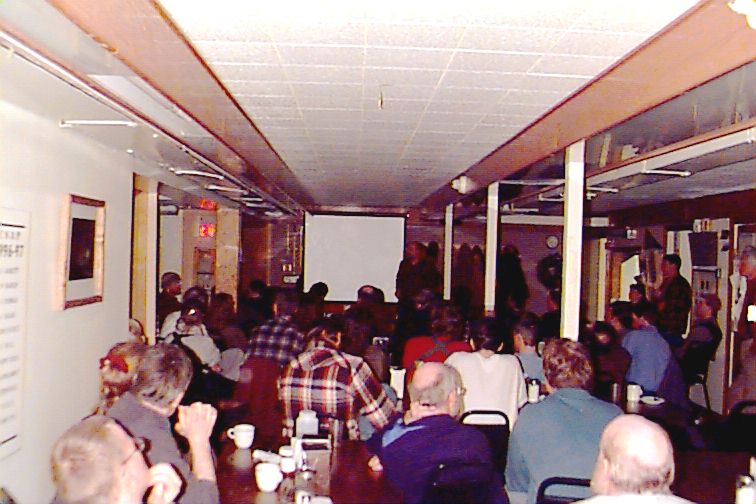
This evening, after dinner, the last Sunday Evening Presentation is held in the cafeteria. Dr. Sukow, the NSF Rep., gives a slide show on his hobby of studying agates. The room is filled: we get a refreshing intellectual change from the usual concerns of one’s experiment, construction problems, snow and cold. A week from now, most of the summer people (including myself) will be gone. It must be a strange feeling, flying away from people you have come to know over a period of weeks or months, leaving them behind for 8 cold and dark months at the end of the world, yet in contact by e-mail.

I have finally figured out a clothing regimen that works for me, for what I am doing. At first I wore way too much: too bulky, too hot. Then, once, I got cold. Now I have settled on the following menu. Firstly, ‘conventional’ underwear: cotton boxer shorts and t-shirt. Next, a set of NSF-issue long underwear, ankles to wrists, light brown color, some kind of lightweight synthetic material. Then, NSF-issue heavy wool boot socks, and the flannel-lined jeans that I bought at home. These go into the huge white bunny boots and I am warm enough from the waist down. On top, a thin turtleneck shirt, dark blue, and finally a blue chambray work shirt, with the script-cursive red embroidered oval namepatch ‘Tony’. I look exactly like a gas station attendant or a maintenance man, but it is practical and fashionable in this milieu. More than one person has commented on the usefulness of the name patch: there are a lot of transient personnel, scientists and engineers and so on, and no-one knows who anyone else is. Now, all kinds of people know me: ‘Hey Tony, pass the sugar please’ and so on. For going outside, I wear the NSF-issued black zip-up fleece underjacket, enough in itself for short trips between buildings; and finally the bright red official parka. My Russian-style fur hat goes over the very necessary UV goggs, the fleece jacket zips up over my chin, and I am ready to Step Out in South Pole Style. They issued me with a zillion different pairs of gloves: I have found that I only need the lightweight fuzzy-lined tan leather pair, but I carry the knit undergloves to keep fingers warm when taking pictures.

I talk to Don Neff some more, after Dr. Sukow’s presentation. Don is a thoughtful guy, sensitive to how people feel and work together. It must be a challenge, having tough-as-nails construction workers on one side and primadonna scientists on the other. Somehow he manages to make it all work, and I shall enjoy working with him. We go to the computer room (the satellite is ‘up’ now) and look at my journal on the web pages. He chuckles as he reads some of my more specious text. The pictures come clearly on the screen: we see the power of the digital world.
And so to bed. Who knows, my equipment might arrive tomorrow on the plane! – I had better be ready.
Journal Entry:
At the South Pole
Monday Feb. 3
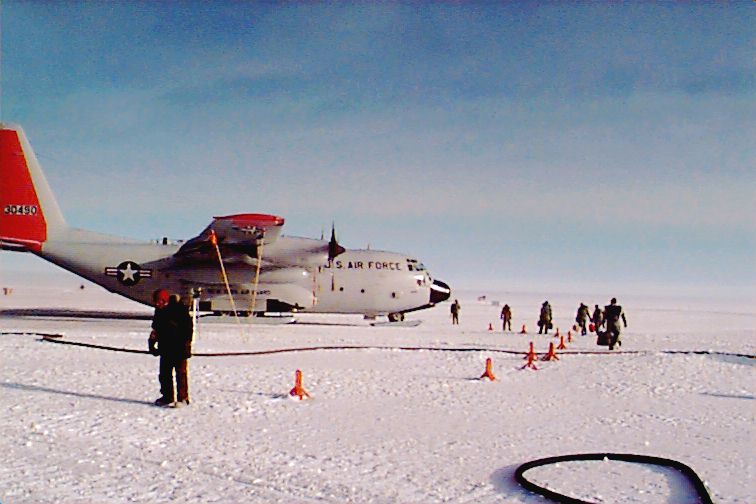
At last my equipment is due to arrive. I go out to the runway in time to see the plane land: in eager anticipation, a herd of snorting Caterpillars are waiting, emitting loud purrs. As soon as the plane halts, the activity begins: no time can be wasted. The passengers climb down the ladder and walk towards the Station: they include Dr. Jane Dionne, the NSF program manager for my main project, and also Dr. Harry Mahar, with whom I will be measuring the aircraft engine emissions in whose toxic cloud the ground crews have to work. The point is, that the aircraft engines can not be allowed to stop: in the intense cold, then engines might not re-start, or something might get damaged if it froze and was then abruptly turned. Thus, the aircraft’s four engines roar, the propellers spin like wheels of death, and the ground crew do their work in a blast of turbine exhaust. Imagine riding a bicycle right behind an old school bus. Now imagine doing heavy labor in similar exhaust, drawing deep breaths at a physiological altitude of 13000 feet – in temperatures of 40 below. The Cargo-Operations crews have been developing symptoms and complaints: they are immersed in exhaust for almost an hour. For this reason, the NSF is studying the emissions to see if respirators or other protection will be needed.
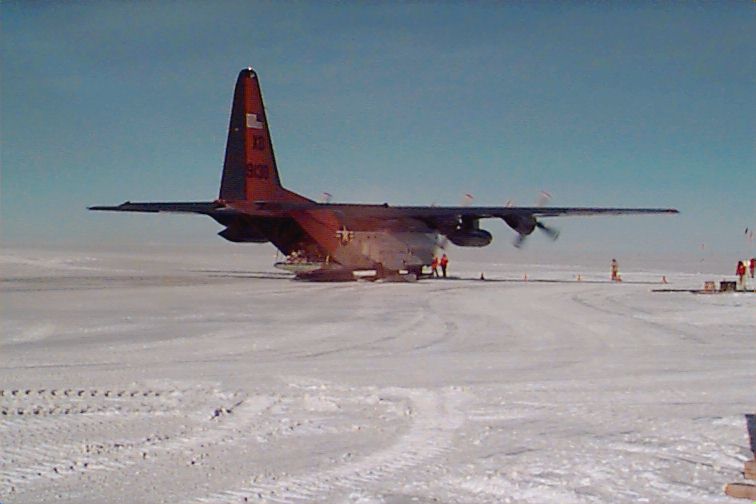
So I watch, from a safe and less-deafening distance. Cargo comes off on pallets and bundles and onto fork-lift dozers, until the plane is empty. All this while, the plane’s excess fuel is being pumped out into a storage tank – this is how Pole receives its fuel. Finally, the Giant Dozer right behind me emits a Giant Belch, and starts dragging a huge tank strapped to a sled. It backs up behind the plane, and the tank is winched inside. The noise of the aircraft engines is deafening, the blast of snow from the propellers mixes with the exhaust from the turbines.

I reflect quietly. Not a Fun Job. Am I privileged, or was I lucky?
But my reverie is shattered by the magic of peripheral vision. I’ve seen those boxes before .. those, there in the bundle on that pallet getting taken to the Warm Storage Shed. Yay! – my equipment finally arrived!! Yes, those boxes getting thoughtfully flattened under the treads of a behemoth, for easier delivery .. but seriously folks, no, they clanked away safely to the inner recesses of Cargo Ops.
Those four boxes .. all the way from Berkeley. I paraphrase the Late Jerry Garcia: “What a long strange trip it’s been”. Twenty years ago, a germ of an idea at a desk, a research curiosity. Eleven years ago, a work bench in a garage. Today, a fully-professional instrument is made in Slovenia and distributed world-wide. And here I am, now, watching the boxes go by at the South Pole. I feel like a proud father at his child’s graduation. I feel older. But then I say to myself, “Nonsense, I’m here on an amazing adventure as a direct result of all those late evenings, the persistence, the toil. It’s not over yet.”

I think of a scene from the movie ‘Down and Out in Beverly Hills’. Danny de Vito plays a businessman who has made his fortune by manufacturing coat hangers. He is appalling, as are his family. At one point, he’s at home, talking about his business. His daughter says something like “Hangers? – I *HATE* hangers!”. Danny de Vito’s eyes bulge and he screams at her: “Hangers? HANGERS??? Hangers FEED you, hangers CLOTHE you, hangers PAY FOR YOUR DAMN BOYFRIEND….”, you get the idea.
Well, for me, it’s soot. Soot in the air. ‘It’s a dirty job, someone has to do it’. [Gong]. The humble soot particle, the oldest pollutant, has gotten me here to the South Pole.
But now what? – I must ransom my boxes from Cargo Ops, and the rumors are Not Pretty. Don Neff pulls me aside into his cubicle, and in a conspiratorial whisper he says the word: ‘Chocolate’.
I look as blank as I can, given years of training. Don repeats urgently in a monotone: ‘Take chocolate’.
For an instant, my blood runs cold, the short hairs on the nape of my neck wake up. I didn’t *BRING* any chocolate. It didn’t say anything about that, in the official NSF publications. Will my equipment languish in the storage shed until it’s time for me to depart? – this IS the Government, after all.
Don cracks a smile. I had almost believed him. He pulls open his bottom desk drawer and reaches way in the back to an unmarked box. He pulls out a Snickers bar. “Go talk to Diana in Cargo Ops, she’ll get you your boxes”. I go limp, accept the candy bar with a whispered word of thanks and walk through the labyrinths to Cargo Ops.
Suddenly, pathetically, I feel like an Old Hand. No clueless Beaker this, trying to do things according to official procedures. I am empowered, privy to the inner workings, and able to introduce myself to people on a first-name basis. I have overcome altitude sickness. By the time I get to Cargo Ops, my boots barely touch the snow.

Inside the brand-new office, cheerful and competent women greet me. I offer my dowry, the Snickers bar. They laugh. “No problem”. An older woman is there in brown work overalls. “Sharon will get them out of the shed for you”. As we walk over to the shed, I ask Sharon how she likes being here, doing manual work. She replies “I didn’t think they’d accept me, being a ‘mature’ applicant” – but here she is, a dozer driver and cargo hand at the South Pole. And why not? why not this, than a job in a library or a wicker chair in retirement, if you can do it? I am very heartened, I no longer feel old, the future is boundless.

Sharon Tredway on her Cat.
To follow a little more of Sharon’s story, click here.

We load the boxes into a van, and drive over to the New Clean Air Facility building. It is a giant blue box on stilts: it is BRAND NEW, and the carpenters and electricians are just finishing up while the scientists are moving in. Two things are not yet completed: the lack of plumbing hookup has led to the placement of an outhouse on one side. The outhouse overlooks the endless expanse of the Polar Waste outside, while providing an opportunity to create polar waste inside. The outhouse is unheated. Almost anything you can imagine is true. The other thing not yet completed is the hoist. The four boxes, 70 pounds each, must be carried up two flights of stairs. I expire again. The air is still thin, though Sharon says she’s used to it.
The aethalometers have arrived safely at 5 PM. By 8:30, I have unpacked them, missed dinner, and am listening to them humming away, sitting on boxes. Tomorrow I will get a table and an air inlet. They are working PERFECTLY, the two of them show identical readings on the indoor air. I am SO RELIEVED. No breakages, no problems, just out of the box and plug in: just as I told Jane Dionne, my manager …. who is now here.
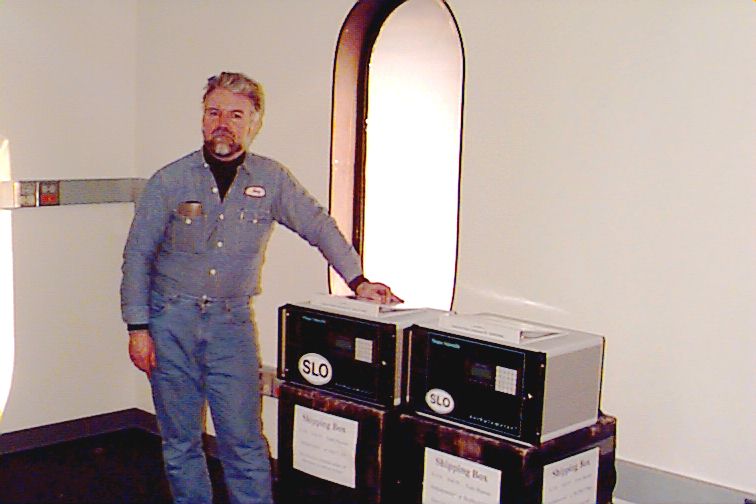
The aethalometers are made in Slovenia: and my friends there had told me that these will probably be the first Slovenian products to ever reach Antarctica or the Pole. An article had been written last week in the main Slovene newspaper ‘Delo’, the Minister of Science had been very pleased. I brought two ‘SLO’ decals with me: I took their pictures on the instruments, and then again on the Ceremonial Pole, and I sent the pictures back to Mirko. “Pozdrav z juznega tecaja”, and as I walked back to the Dome I whistled the tune titled “Made In Slovenia” by the very talented Slovene country-and-western band ‘Pohorje Express’. ( you ain’t NEVER heard country tunes till you’ve heard them sung in Slovene, yet with a Western intonation).


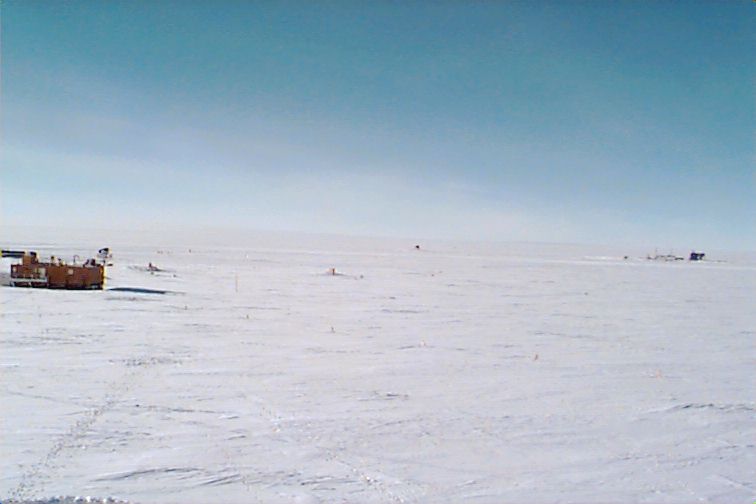
Back at Clean Air, I went up onto the roof for a panoramic view. It suddenly hits me: we are an island in an ocean of snow and ice. In Cherskiy, they used a term to refer to the European part of Russia, the unfrozen part with farms and cities: they called it the ‘Continent’. They would fly back over 8 time zones across the tundra, back to the Continent. They were islands too, and in the old days the islands along the Kolyma constituted the Gulag Archipelago. I look out across the flat expanse of the South Pole, sere and cold from horizon to horizon, with a camp in the middle: add a few spindly trees, it is Yakutia, and I am Ivan Denisovitch.
Journal Entry:
At the South Pole
Wednesday Feb. 5
Yesterday (Tuesday) was relatively uneventful: I finished my installation at the New Clean Air building, and unpacked and prepared everything for the aircraft-exhaust sampling project. On my shelves in Berkeley I’d had a very old aethalometer, one that I hand-made in 1987 that had been returned after a project. This was a good opportunity: I could modify it to work at a high flow rate and give data every 5 seconds. The plan was to drive back and forth in a truck at different distances behind the aircraft, with the equipment on the back seat and power from a generator in the rear. The equipment was all OK, and it ran fine in the lab when unpacked and set up.
The next morning (Wednesday), I had to get up early to meet Harry to get started. Thus, I set my alarm clock, and programmed my brain to respond. My alarm clock is the type that starts quietly: Bip-bip, bip-bip, bip-bip. Then, louder: Beep Beep, Beep Beep, Beep Beep. You probably know the kind. Well, so (evidently) did three other of the residents of my tiny sleeping building with barely-private concertina-partitioned cubicles. At 5:30: bip-bip, bip-bip, bip-bip. I awake instantly, not wanting to be late for my project. But it hadn’t been *my* alarm: I hear shuffling noises in another cubicle, then the door to the outside opens and closes. At 6:15: bip-bip, bip-bip and the same instant-on. More shuffling, still not my turn, nor again. At last, it IS my turn to wake up, but I’ve done it three times already.
At breakfast, there are unidentified objects on a tray at the back. Flat, rectangular, sort of crispy-looking when seen from a distance. With great enthusiasm I ask brightly: “Are those spam fritters ?” The immediate silence is like a chemical-warfare attack: everybody in the vicinity gags.
“WHAT?”.
“Spam fritters?” I suggest, more humbly, please?
Then the laughter begins. “Spam spam spam spam spam spam spam spam” they sing from Monty Python.
“No really, are they?”.
Now the hilarity begins. They have never even HEARD of spam fritters. I try to explain, but I have long lost all credibility. The items in question are lemon squares, slices of some sort of a flat cake. I try to creep away invisibly, but that is hard to do here.
After breakfast, Harry and I must set out marker flag poles in the snow, so that we will have a grid of lines to judge our distance when driving behind the plane. We take an armful of flags and a 200-foot measuring tape, and trudge out into the sunshine. It is 42 degrees below zero, 58 below with windchill. Starting at the point where the planes line up after taxi-ing in, we measure out 5 spans of 100 feet each, and plant flags. We then remember our Euclidean geometry and construct giant arcs in the snow with a larger radius, whose intersections give us a matching parallel line of flags. It takes a surprisingly long time: I am starting to get cold, since my clothing is selected for walking between buildings, not standing still on the end of a tape.
Now there is a problem: we have marked out two parallel rows of flags, but the runway is curved and so the rear flags are no longer to the side, but are right in the middle of the taxiway. We set up new pairs of flags, maintaining the correct alignment but moved off the runway. Now I am cold indeed.
Harry calls out: “Stand by those flags there, don’t let any Cats (bulldozers) knock them down, I’m going back for some marking material”.
I guard Harry’s flags. I stand off the Cats like the famous image of the single Chinese man defying the tanks at Tiananmen Square. I get colder yet. I zip up everything that zips, tuck in everything that tucks. My mustache ices over from my exhaled breath, my cheeks burn, my goggles ice over, the fur rim of my parka hood grows ice. I cannot see: but I stand firm by my flag, and Heaven forbid that I should hear a nearby clanking sound. At last, a figure swims dimly into view through the hoar frost on my goggs. “Sorry it took me a while ……”. To his credit, Harry has been very inventive: unable to find anything else, he has come back from the kitchen with a container of concentrated orange juice. Poured on the ground, it makes a clearly visible spot in the white snow. I relinquish my flag, creak off and eventually thaw out, feeling like something from an old Tom-and-Jerry cartoon.
We are ready just in time: we put the generator in the back of the truck, run the cord through the window to power the equipment, and push out a few feet of plastic tubing to the front of the truck’s hood to collect the sample at the same height as a person breathing. The plane lands, roars down the runway to its appointed spot, and from our furthest distance of 500 feet we look right up the four turbine exhausts as the engines run.
It looks awful.
We start directly towards the plane: Harry is driving, and watching for the flag markers; Liza from Ops is in the front passenger seat with her radio, watching for Cats and keeping us out of trouble; I am in the back seat of the crew cab with the equipment.
As we get up to the plane, the BC (black carbon) numbers become HUGE.
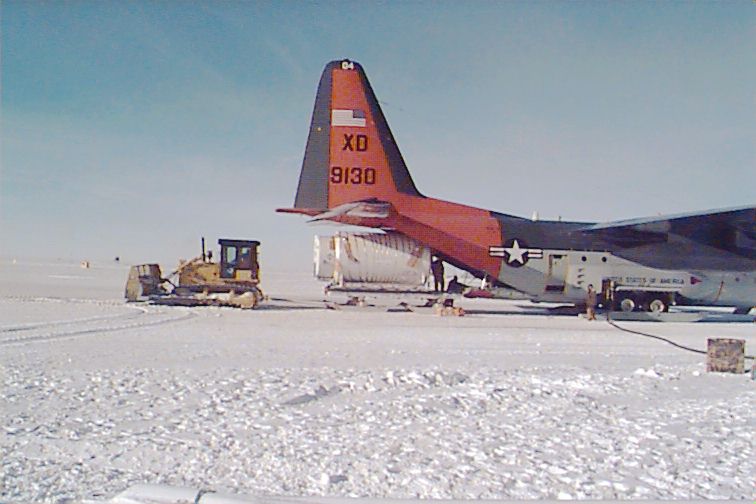
No wonder they complain, no wonder they get medical symptoms. How much harder must one breathe at 13000 feet? The world of Cargo Hands is suddenly transformed from a romantic view of empowered women operating heavy equipment with skill and professionalism, into the same great job elsewhere on the station, but punctuated twice a day with a session in Jet Engine Hell.
And that, after all, is why I am here: this is the problem being addressed by the NSF program that approved my proposal. If there were no problem, I would never have had this opportunity; but now that I am here, I have to see it.
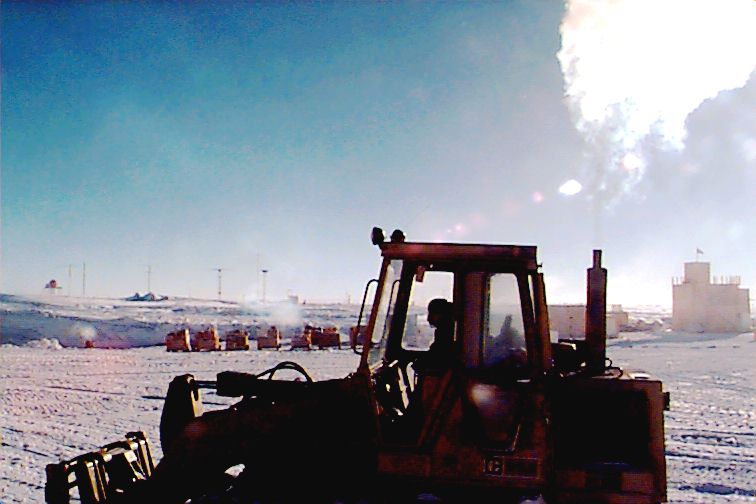
Thinking about my other professional observations of chimneys and exhausts, as a Soot Veteran would, my view of the Pole is now tarnished. The Beakers (scientists) set up state-of-the-art equipment in incredible clean new buildings overlooking the pristine Polar Plateau. Supporting them downwind, a brown-clad underclass toils in a partial vacuum filled with diesel fumes.
Journal Entry:
At the South Pole
Thursday Feb. 6th
–More aircraft exhaust, more measurements. This time, Harry parks the truck under the wing of the plane and walks out into the ground crew work area with a 50-foot hose. We get readings where they stand, where they jockey the cargo pallets, where the Cat drivers must wait while their loads are being secured. The roar of the engines is deafening: I am directly underneath them. Harry is walking around in the blast from the propellers – this is *his* project, after all.
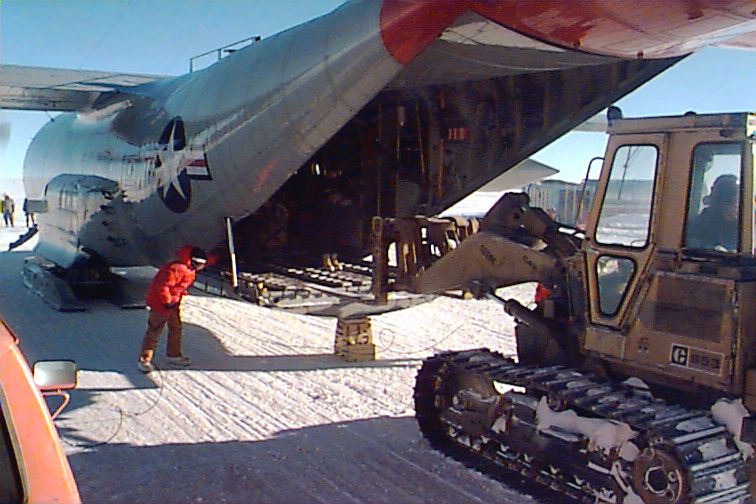
We get lots of data, and I prepare it in the form of a map of concentrations over the grid of positions. It is clear that by moving slightly to one side, or staying further back, the exposure of the Cat drivers will be greatly reduced. We call a meeting of the Cargo Ops people and discuss a number of other possibilities – they are very relieved that finally their situation is being investigated. Certainly by next season, they will have a plan.
Who would have thought that there would be so much exhaust associated with the operations of the South Pole Station? – certainly not I. Yet at the end of sampling the second plane today, Harry and I looked toward the horizon in the downwind direction from the aircraft. It had been a difficult birth, getting the cargo out – the plane had been running on the taxiway for almost 2 hours. The distant horizon was completely obscured by a black layer of smoke, raised slightly off the surface by its original warmth. I wonder how big this smudge on Antarctica is, seen from the air?
Journal Report:
At the South Pole
Saturday Feb. 8th
For some people, the term ‘DV’ might be mistaken for an allusion to an unpleasant form of ‘gastrointestinal distress’ (euphemism). However, for the managers of a high-profile location such as the South Pole Station, the term ‘DV’ is one that *INDUCES* gastro-intestinal distress: for it refers to a situation that can not be cured by 2 pills in a glass of water. The term ‘DV’ that strikes fear and loathing into these people refers to that most ghastly of apparitions incarnate: the Distinguished Visitor. In groups of N, the effects are not just multiplied N times, but the disruption and inconvenience are enlarged to the Nth power.
It seems that there are 2 categories of DV recognized by the local management: the ‘OK-DV’ and the ‘F-DV’.
The OK-DV is often a senior scientist, or senior manager. This person is treated with well-deserved respect: the person recognizes that station operations are complex and intense, and attempts to minimize his or her impact. The purpose of the visit is often to conduct on-site reviews or inspections, or to confer with local science or operations leaders. The OK-DV is rarely seen, spending most time in offices or laboratories. The OK-DV’s goal is to become invisible and non-disruptive, so that the acts of inspecting and conferring represent the true, equilibrium state of affairs here. Another category of OK-DV is the Truly Famous Person, whom everyone wants to meet anyway. The disruption in this case is more than worth while: Sir Edmund Hillary, for example, the first Westerner to climb Mount Everest and the leader of the first Trans-Antarctic Expedition, who visited Pole a few weeks ago.
However, there is another category of DV, the so-called F-DV. The prime characteristic of the F-DVs is that they come for *NO REAL PURPOSE* save as a junket for themselves. The primary goal of the F-DV is to be photographed at the Ceremonial Pole, to be photographed in front of the entrance to the Dome, to get a postcard mailed with a South Pole stamp imprint. F-DV’s contribute nothing of immediate substance by their visit, although unfortunately they are often in positions of undeserved power and influence back home, and must therefore be humored. Candidates for this category can be drawn from high-level academia, politicians, and high-ranking military. Somehow, in a distant manner, they find themselves in an upper box on an org-chart that contains a reference somewhere to Something At The South Pole. Voila! – the junket is conceived, the camera is loaded with film, the administrative assistants are told to make the necessary arrangements.
Of course, said F-DV’s are very sensitive to the nature of their visits: they have achieved their positions by careful attention to politics and promotions. However, what puts the prefix ‘F’ into their descriptive code is their total disregard of the intensity of station operations, their lack of consideration for those who have jobs to do, their arrogance derived from the habitual exercise of substantial power. This last attribute forces one to Express No Opinions, Name No Names, lest the lightning of Official Disapproval strike one’s cubicle, one’s project, one’s career.
So here we are at the South Pole, only a FEW DAYS before closing – i.e. there is LOTS for everyone to do, before the last plane departs for the winter. The dispatcher announces over the PA system: “aircraft 10 miles out, on-deck at 11:45, fifteen thousand pounds of cargo, six thousand gallons of fuel, one passenger, seven DV’s “. A great groan of disbelief goes up in the galley. SEVEN DV’s ? … THIS LATE IN THE SEASON ??
It is part of Don Neff’s job to give brief tours of the facilities and projects to DV’s of every type. Characteristically, he smiles, pulls on his jacket and goes to get the keys to a vehicle. His management responsibilities will have to be temporarily set aside.
The plane lands: from a distance, I see the one passenger disembark and walk towards the station dragging his bag. Perhaps a returnee for the Winter. The Cats are working at the rear of the plane to extract the cargo: the Fuel Team is pumping out the excess fuel and transferring it to the Station tanks. Eagerly waiting in the galley are the 19 people who are scheduled for departure today. Some of them have been here since November: all of them have schedules to keep, colleagues and loved ones to eventually meet. I see Don driving the DV’s around in a snowcat: they are peering out of the windows, but their real goals are elsewhere.
The engines of the plane are running, as is usual. Several hundred gallons of precious fuel per hour. As soon as the freight is unloaded, the announcement is made: “All departing passengers please proceed to the aircraft”. With final good-byes, they gather their bags and walk up the hill, out of the Dome, and towards the plane that will take them from this monochromatic world back to civilization.
I am outside, waiting with the video camera to get some footage of a plane departing in a cloud of exhaust. I am slowly freezing, as I am standing still. Now, the DV’s are at the Ceremonial Pole. It’s right next to the plane: but they don’t walk over and climb aboard: they get back into the snowcat and Don drives them down into the Dome. I am really freezing, so I figure that the walk will warm me up. I end up in the galley, looking for someone who can give me an idea of when the plane will be taking off.
Inside the galley, our F-DV’s are cheerfully sitting at the tables, drinking coffee and eating slices of cake. They are chatting to the pretty galley ladies, and other women staff. If dressed in red-checker wool shirts, they would perfectly resemble a group of Good Old Boys back from a hunting trip, chatting to the waitresses in a diner in Wisconsin.
They get their coffee cups refilled.
Outside on the runway, the aircraft engines are roaring, the 19 passengers are sitting inside the hold of the plane in the belly of the netherworld.
Back in the galley, the DV’s finally decide that now it’s time for them to get their postcards of the South Pole with the official stamp. They exit, laughing and joking. What a great trip – the South Pole! I calculate that it couldn’t take them more than a few minutes more, so after a bit I put on my coat again and go out onto the runway. The plane is exactly where it was, its engines still running, its tail rudder swishing back and forth exactly like the tail of an angry cat, as the pilot wondered what the *** was going on, and watched his fuel gauges.
I stand on the runway for another 20 minutes or more. I am freezing again – and so is the battery in the video camera. Eventually, the DV’s emerge from the Dome entrance. They are slapping each other on the back. They pause for some more pictures of each other, and walk gradually over to the plane.
Oops! – forgot a particular shot of the Ceremonial Pole; a shot of each one climbing aboard the plane. The aircrew salute, the last one gets on board, the ladder goes up.
It is 1 hour and 15 minutes since the freight was offloaded, at which time the plane would have been ready to depart. Nineteen people, who just put in months of dedicated hard work in 40-below-zero conditions, have been given the privilege of sitting in the hold of the aircraft for an hour and a quarter so that our Good Old Boys can chat with the galley ladies over coffee.

The plane takes off and flies away. I am disgusted, as well as being encrusted with ice over my face and beard.
But then ……. !

Back in the Dome, it’s Saturday night! – of all things there is a BARBECUE on the snow outside the galley. Perhaps it had been hidden until the F-DV’s departed. Steaks are sizzling, a huge cloud of greasy smoke is going up inside the dome. “Grab a plate” they call out. Inside, margaritas are being mixed – and good ones too, with tortilla chips and fresh salsa. FRESH SALSA ?

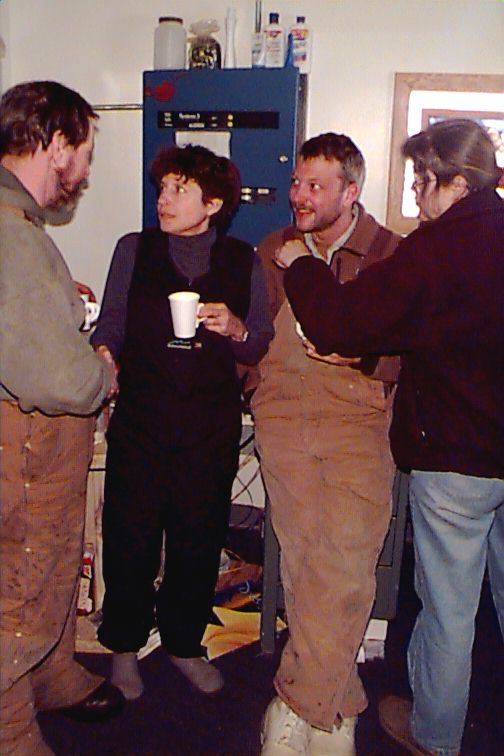
Now I am really disoriented. A moment ago, crass inconsiderateness by a bunch of Good Old Boys, by whose hour-and-a-quarter delay I froze my fingers and face in (windchill) 60-degrees-below-zero conditions, and got riled. A moment later, I am surrounded by people who have become my friends in this last long week: I am eating a steak with chips and salsa, and drinking a darned good margarita.


What in heck is going on ? Am I really here ?
Journal Entry:
On board the Hercules from Pole to Mactown
Monday, February 10th
I am writing this part on board the Hercules: today I departed from Pole, to begin my long transition from ice to non-ice. In literature, rites of passage usually *begin* with a challenge, and are initiated in ceremony. The long journey back from Pole, however, begins with waiting around for the plane. There’s a marker in the snow, from which point all directions are North. This morning, the direction is Sit.

My bags are packed, my tiny sleeping cubicle is cleaned out. My suitcase and orange ‘Hold Bag’ are dumped on the snow: the former full of clothes I didn’t wear, the latter full of issued ECW gear I didn’t wear, just out of circumstance. Both will be tossed into a steel skip on the front of a Cat to be taken out to the plane, and are cooling off nicely right now. “Take your bathroom bag with you”, they said, “don’t let your toothpaste freeze”. My briefcase and a couple of items of ECW gear are stuffed into another orange ‘ Hand Carry’ bag to take on board with me.
Our work is done, our projects brought to conclusion for this season; the contractors have put in their last shift. We sit in the galley and wait for the plane. Groups that have become buddies exchange addresses, tell final improbable tales. For most of them, they are both glad and sad to leave. Glad, to be leaving the monochromatic world of cold and snow, where every task is intensified ten-fold.


I have another cup of coffee, and visit the bathroom again. “Plane on deck” announces the PA. I go out, up the hill from the Dome, and out onto the flight area to watch Cargo Ops unloading. The sky is overcast with an icy mist, no sun at all and the wind is blowing enough. Probably 70 below zero with wind-chill. I look at the smoke from the engines: in the last couple of days we have had some ideas about how to reduce the exhaust concentrations where the drivers have to work.


Like a modern-day Snow Princess, Diana from Cargo Ops is on her Cat, her face and hair framed in delicate threads of ice. In a few days, she and her staff will write themselves their own tickets out of here, and the Cats will be tucked in for a long sleep.


The engines roar, the fillings in our teeth vibrate and Pole Station recedes through the scratched windows into a tiny dot in the vast white flatness: an outpost of mankind at the End of the World. Unlike other remote places, this one is doing more than just barely hanging on: instead, it is equipped with the most advanced scientific equipment peering into the cosmos, the most sensitive instruments studying the earth and space. If Robert Scott were to awaken from his icy grave and trek back across the Polar Plateau, he would be astounded: a miniature city on and under the ice, with running hot water, fresh fruit and satellite communications. There is no strategic value to the location: this high-tech dot on the map exists purely for the sake of science, and science in its purest sense for the sake of knowledge. And smoke in the air, alas.


After an hour, we pass over the Trans-Antarctic Mountains: for the first time in a week, my horizon is not perfectly flat in all directions, though the windows add an interesting distortion. I’m sitting on one side of the aircraft: there’s a draught and it’s 19 degrees F right here. (Where does the draught come from? – yikes.) I pull on my ECW bibfront pants, I am colder than I have been for a long time. Again, the Man in the front has the Knob, and probably a small mirror: we passengers know that the Air Force will wait until we’ve pulled on every last layer of clothing, and will then turn up the heat to ‘MAX’. The air crew are professional military men in professional military gear with short military haircuts: the returning Polies are a rag-tag bunch in worn insulated coveralls, torn jackets and stringy unwashed hair. The freight load being retro’d is garbage for recycling: how do the crew view the passengers?

The plane dips and turns, dips and turns. We don’t land: ‘It’s fogged in’, we think, ‘we’re returning to Pole’. But no, the plane was being used for radar calibration and had to circle a number of times. We land at Willy Field on the ice shelf, and the view is spectacular, if simply for the fact that there *is* a view. There is no view at Pole. Mount Erebus looms over the landscape, its summit catching clouds. The van speeds along on the smooth snow: we are on a freeway. The passengers sit quietly, thinking of the pending transformation in their lives.
Dirt —-

We drive off the ice, and up onto the dirt road on the east side of Ross Island. Dirt. Dirt everywhere. Dark-gray gritty volcanic dirt. This dirt produces no dust, and therefore no country-and-western nostalgia, no truck ads. Non-romantic dirt. The tires crunch, we drive over the crest of the hill and into the back side of Mactown. Past storage yards of construction equipment and supplies, shipping containers, mounds of pipes and girders, spools of cable all neatly stacked on the dirt. Past fuel tanks, penned in against spillage by berms of dirt. Finally into town, built on the dirt. After ten days of white snow in all directions, the sight of rows of three-story buildings painted brown assaults the senses.
I forget whether transitions like this are nodes or antinodes, yin or yang. The white and the black swirl around each other, and each has a dot that connects to the flip side of the coin. Perhaps the dots represent the trance of travel by Hercules, from white to black. Flip the coin again, pass through another dot, and the world turns green in New Zealand. Go the other way: 8 more months of white.
The Mactown sky is overcast and gloomy: the wind is much stronger than at Pole. The black hillsides have patches of snow remaining, old snow that hasn’t melted. Like Pole, McMurdo is also monochromatic: dirt and white, instead of white only. I change out of my ECW bunny boots into hiking boots: my feet are several pounds lighter. Adding the fact that the outside temperature is warmer by 60 degrees F, and there’s 50 percent more air, (the barometric altitude is 10,000 feet lower), I skip over to the dining galley in just my fleece jacket. The food is Good Cafeteria Food: but not the home cooking of Pole. There is a *CROWD* in the dining hall. A crowd!! where did all these people come from?? A crowd so large that you could not expect to recognize every face in a season, let alone a week. The magic has gone, dissipated in a crowd.
Finally, the Rivalry Question: “Is McMurdo Antarctica?”.
Geographically: yes.
The view: definitely.
The town: definitely not.
This place is a Government mining camp of great activity and unrevealed purpose, the perfect setting for a B movie.
Journal Entry:
McMurdo
Tuesday, February 11th
I sleep surprisingly well, despite the increase in air pressure, but awake cold. The reason is that the window in my room is open a tiny crack, and the wind is howling. Not a breeze, no tropical zephyr. And not ‘Wind’, nor ‘WIND’ such as they get here in the winter. Simply ‘wind’, but more than I ever felt at Pole – thank goodness. By comparison with riding my motorscooter, I guess that this wind is maybe 30 mph (50 kph). The actual temperature on my thermometer is 9’F, so with the wind chill it’s quite cold. Tiny flakes of snow are zipping along, reminding the population of Mactown that summer is over, and Winter is not far behind.
Having missed breakfast, I eat a meal in the galley at a time that is described on the board as “Early Lunch”. I like this description much better, and to appear virtuous I eat fried chicken with rice rather than cereal with milk, which *is* available but which would have to be eaten surreptitiously. Then I think to myself .. “Why do I care? If I want to eat cereal, implying breakfast, implying that I slept late, What Does It Matter? – will the Lunch Monitor put an X on my attendance report? ” It is in these ways that the ghosts of one’s rigorous early education are found to be closer to the surface than one would wish. Despite all this, despite the fact that absolutely no-one here either knows me OR cares how late I sleep, I eat my pretend lunch as if I started work at 6 AM, and get to my eleven o’clock meeting in plenty of time.
“Bag Drag” is announced for 3 PM for our flight to Cheech (as Christchurch is called, from CHC). This means that a list of people must present themselves at the specified time to be weighed, together with their luggage and single carry-on personal bag. The aggregate weight allows the crew to calculate load and fuel: the flight from Mactown to Cheech is almost at the limit for a Herc. If there are headwinds, extra fuel will be taken, and some passengers will be dropped according to the “Bump Priority”. The lower the number, the better your chances of getting on board. Senior staff are always zeros; I am an 18; returning contract workers may be 30’s to 50’s. If they decide they can take 42 passengers, then numbers 43 and up will simply have to wait.

The Bag Drag procedure is simultaneously logical and illogical, sensible and Government. The overall idea is to get an exact weight of the pax (passengers) plus their luggage, in order to be able to accurately calculate the aircraft load. Each passenger is allowed 75 pounds total of luggage. Sharon from Pole is in line near me, next to a Big Military Guy. She weighs maybe 100 pounds: yet her luggage is ten or twenty pounds overweight. GI Joe probably weighs 250 pounds: his luggage is acceptable. Sharon pulls out a whole bunch of books and boots from her luggage, and I stuff them into my bag. She passes the weight test. I give them back to her to put into her carry-on, and then *I* pass the weight test. The Bag Drag Lady doesn’t mind at all: as we step on the scales, the computer registers the total.
Now come the Pronouncements. The Bag Drag Lady looks us all fiercely in the eye: she has processed hundreds, thousands of returning contractors, servicemen, graduate students. “Check the announcements for your reporting time. Do not be late. If you are late for reporting, or if you report in an intoxicated state, you will be automatically bumped”. Like children being separated from their parents, our checked bags are taken away from us, and we are discharged into the wind clutching only our orange ‘Hand Carry’ bag containing whatever we were prudent enough to keep. If the flight is delayed, we shall have to exist on those contents for an indefinite time. Clean underwear? – toothpaste? – in your checked luggage? With misplaced priorities, some people keep with them their scientific notes, *which they will not need*, yet relinquish their clothing and toiletries for a two-day wait.
The wind gets stronger, the temperature drops a few degrees. Since I have the time, I inquire about visiting Scott’s Hut. This small wooden building was erected at the turn of the century and served as a base for early Antarctic operations for about a decade. After abandonment, it gradually filled with snow and ice until it was ‘excavated’ a while ago and restored as a registered Historic Monument. It’s less than half a mile from town, and the key is kept at the NSF office. Another guy wants to go, so I sign out the key and we set off into wind. We walk past the pier, from which I boarded the icebreaker for that wonderful cruise a couple of weeks ago. Then, the pier area was covered with a mountain of shipping containers, mostly containing sorted waste being retro’d to the States. Now, the pier is empty and clean: those Navy crewmen, with whom I flew down, put in their work when the cargo ship arrived, had a few beers, and have already returned. The research vessel “Nathaniel B. Palmer” is at the dock, taking on supplies, but there are no tours this time, so we walk by.

We reach Scott’s Hut. What an amazing artifact, when imagined in its original context. Take away the backdrop of Mactown and try to reconstruct the scene in 1902. No radio for help, no maps, no electricity. Just this one hut at the very end of world, waiting over the winter for the ship to find its way back. Everything inside is preserved from ninety years ago: tins of biscuits and baking powder, tools and implements. The amazing thing is the familiarity of some of these items from my own childhood. Most major brands of goods that existed in England in 1901, still existed 50 years later when I was born, though I may not have seen them personally for a quarter of a century since emigrating. Suddenly, preserved in the most extreme form of time warp, I recognize ‘Huntley & Palmers’ biscuits, ‘Birds’ custard powder, and an ‘Optimus’ camping stove that is *identical* to the one that I had when I went camping as a teenager. But that was thirty years and ten thousand miles ago. Now I am in Antarctica, a second Egypt in its preservation of the past, and I am looking at an excavated tomb.
The wind blows harder: my co-visitor returns to town for his bag drag. I lock up the hut and walk over “Vince’s Cross”, commemorating a seaman who drowned near here in 1902. The cross is on a small cliff of crumbly volcanic rock, overlooking the coldest ocean water I have ever seen. The wind is howling, I can barely stand up against it. Since the air temperature is much lower than the water temperature, the water surface steams in streamers. It is only the force of the wind and the under movement of the water that keeps it ice-free, and this will not last much longer. At Vince’s Cross I try to take photos: but the best angle for a shot is perilously close to the edge of the cliff, and the wind is extreme. It requires very little imagination to visualize peering through the viewfinder, backing up a step to get a better field of view, missing my footing on the loose surface and getting literally blown off the cliff into the icy water and certain death. *FOR THIS REASON*, the picture that I *did* take will have to suffice. I forced myself down the hill against the wind: it’s amazingly hard to put cameras away in inner warm pockets when working against a 40-mph wind at 4 degrees F. I walk over to … the beach.


A little tiny beach, in the lee of the hillside. A beach of shiny smooth black pebbles, the same volcanic rock but polished by the sea. A beach with icicles, no less, hanging from rocks into the water. This implies that the salt seawater is at slightly less than 32 degrees F. The seawater remains liquid while the icicles it bathes in waves are frozen, since they are pure water ice, not salt water ice. The black mountains rise from the ice-rimmed beach into cloud covered tops. The wind howls above my head, but I am sheltered in my little hollow. This, finally, is the true image of a Polar region. I have been here before in the Arctic, and I finally believe that I am here now. No more picture-postcard scenes: this is where the world of water and warmth buts up against the world of ice and rock and death. This is the last view that Stalin’s deportees took with them from Magadan.


I look at this view for a *long* time. It is the violent intersection of three of the Greeks’ primal elements, with Fire being noticeably absent. I turn, and examine some of the smooth pebbles, covered in ice yet washed by water. I turn back, and there is now a seal looking at me, hauled up on the beach a little way away. Where did that come from? Why has the force of life intruded on this purely meteorological scene? I back off, before the seal makes any noise, lest it spoil the abstractness of my contemplation. I climb back over the little hill, away from the beach and into the wind: abruptly, McMurdo comes in to view, and the reverie is gone.
Journal Entry:
McMurdo to Christchurch
Thursday, February 13th
On Wednesday morning I awake at a more reasonable hour. There is less wind, and across the bay there is a hint of clearing in the clouds. Last night it almost seemed to get less light – not dark, but less light. The orbit of the sun is perfectly circular at Pole: the only difference between clock-day and clock-night is the quadrant of the sky. The sun’s elevation angle gradually diminishes (from 19 to 16 degrees when I was there) until it hits the horizon at the equinox, and darkness lasts for six months thereafter. McMurdo is at a lower latitude, so the sun’s orbit is tilted, dipping slightly towards the horizon at night. As the year progresses and the sun angle diminishes, this dip will take it close enough to cause a slight night-time dimming before the equinox. This almost imperceptible effect was my first reminder that I was on my way back to the world from whence I came, a world of different extremes.
At lunch, there was mention of .. PENGUINS ! Aside from their intrinsic interest, penguins are so bound up with the mythology of the Antarctic that to return home having *not* seen penguins would take a lot of explaining. European tourists who visit the United States and see neither cowboys, movie starts nor gangsters face the same dilemma: “How could go all that way and NOT see them ??”. We clothed up and walked down to the pier: on a patch of shoveled dirt of the pier yard, less than a hundred yards from the ship, two penguins stood and ruffled their feathers. Yes, they were cute. Alas, they were placed against an industrial backdrop, instead of the rugged and wild beach by Vince’s Cross, just a quarter-mile away. It was like discovering that the Tooth Fairy operated out of a warehouse in Los Angeles. Conversely, one could say that they brought a little magic to the scene, choosing to arrive from their world, and being able to return to it just as easily. Either way, we dutifully took our pictures , but it felt like doing so in a zoo.
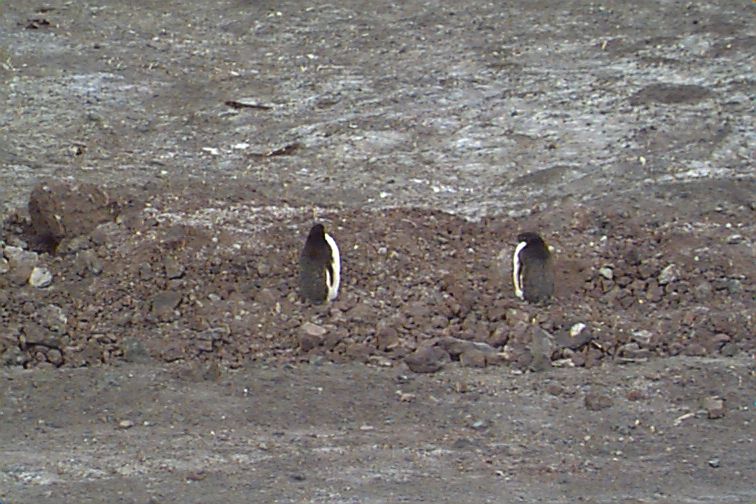
We walked back, and decided that as the view was clearing and the wind was dropping, we would use our last afternoon to climb to the top of Observation Hill. The cross on top commemorates Scott’s expedition, the view was reputed to be worth the 600-foot climb.
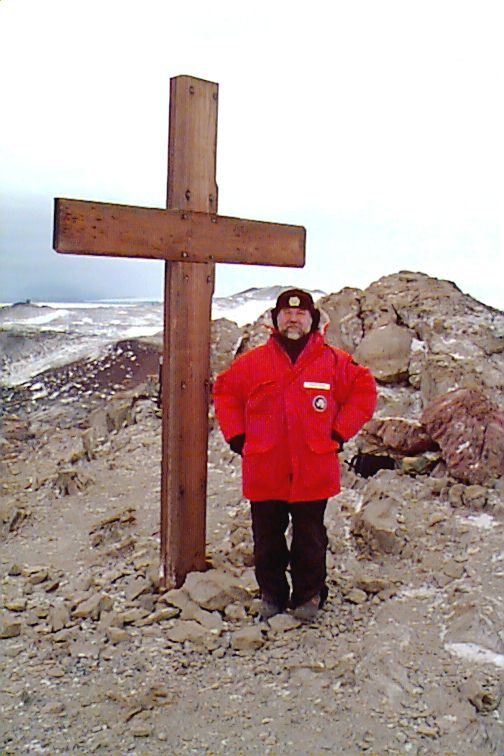
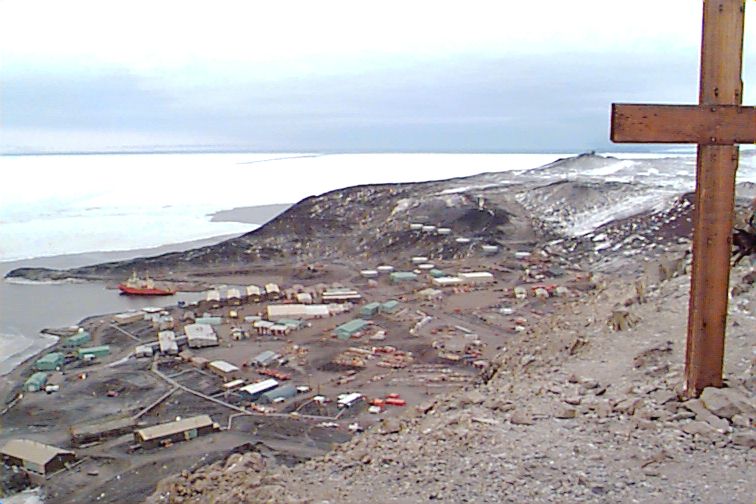
Scott’s Cross on Observation Hill
It was. It was spectacular. To the south and east, the edge of the vast Ross Ice Shelf, larger than France. To the west, the mountains across McMurdo Bay. North, Mt. Erebus was covered in cloud, but we nicknamed the radar domes on two separate hilltops as “God’s Golf Balls”. We fully expected to see feet come down through the clouds, plant themselves on either side of the hills, and – thwack – the ball is driven across the water to an unseen fairway beyond the mountains. Standing on top of Ob Hill, my back to the distant mountains, I got that same View Feeling that adorns any Antarctic picture book. It *was* spectacular.

Me on top of Ob Hill, backdrop of mountains
At our feet McMurdo was laid out neatly, the storage yards in rows and columns. The smooth surfaces looked almost paved, the grit was invisible at this distance. The little world of barracks and galley hall was really a small part of the whole, and completely insignificant against the backdrop of mountains that we now saw as the larger picture. A couple of skuas flew beneath us, and the clouds swirled above. Away over on the ice shelf, one cluster of dots: Williams Field, the snow runway for ski planes. A further cluster of dots: Pegasus, the blue ice runway for wheels. Down there in Mactown, though, one building would be our portal through from here, via those distant dots and onto an aircraft back to the world of green. We knew the transition was going to be bad: none could foresee how bad.
At our feet McMurdo was laid out neatly, the storage yards in rows and columns. The smooth surfaces looked almost paved, the grit was invisible at this distance. The little world of barracks and galley hall was really a small part of the whole, and completely insignificant against the backdrop of mountains that we now saw as the larger picture. A couple of skuas flew beneath us, and the clouds swirled above. Away over on the ice shelf, one cluster of dots: Williams Field, the snow runway for ski planes. A further cluster of dots: Pegasus, the blue ice runway for wheels. Down there in Mactown, though, one building would be our portal through from here, via those distant dots and onto an aircraft back to the world of green. We knew the transition was going to be bad: none could foresee how bad.
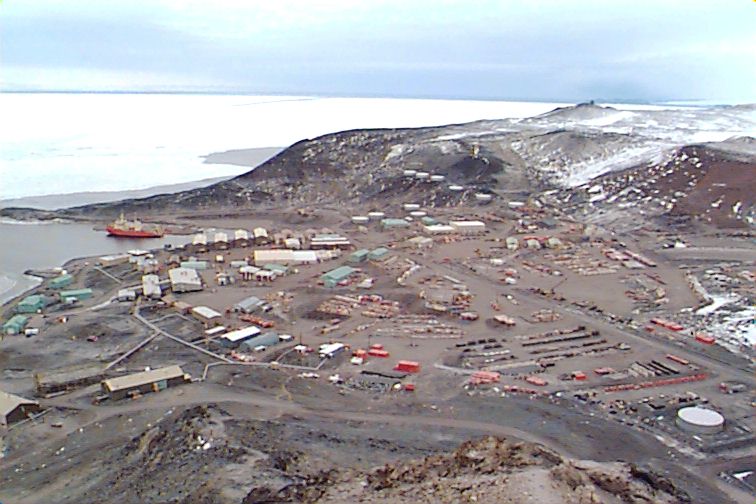
Sharon was the first: she was on flight 40, reporting at 20:00. I was on flight 39, reporting at 22:00. Such was the numbering logic. After 4 months of hard physical labor outdoors at Pole, she sat on her worldly possessions stuffed into orange bags on a cement floor, waiting to be called, waiting to return to her husband, children and grandchildren.
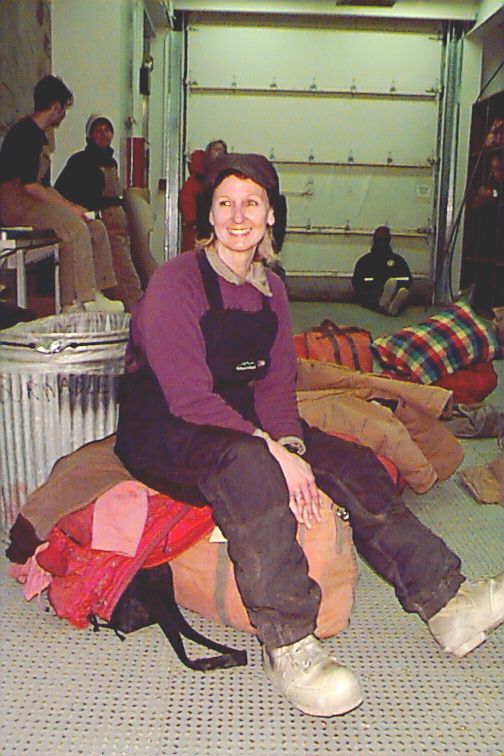
Sharon says goodbye for ever to Antarctica
Two hours later, it was my turn. This time, the reporting area was absolutely full – a very bad omen. Perhaps the earlier flight had a mix of cargo and passengers: it was clear to me that my flight was going to be ‘NOT fun’, an entity that is the Boolean complement of almost anything you could enjoy. We got on the Terra-Bus for the long ride out to Pegasus: the crowd was full of returning military, contract workers, but very few scientists. A bus full of low-priority pax. We waited at Pegasus for an hour or so while the plane got ready. Walking around, we could see McMurdo *way* across the ice shelf, a little smudge with a ship tied up. Now the biggest settlement on the whole continent really did look like the end of the world, the hut that Scott built.
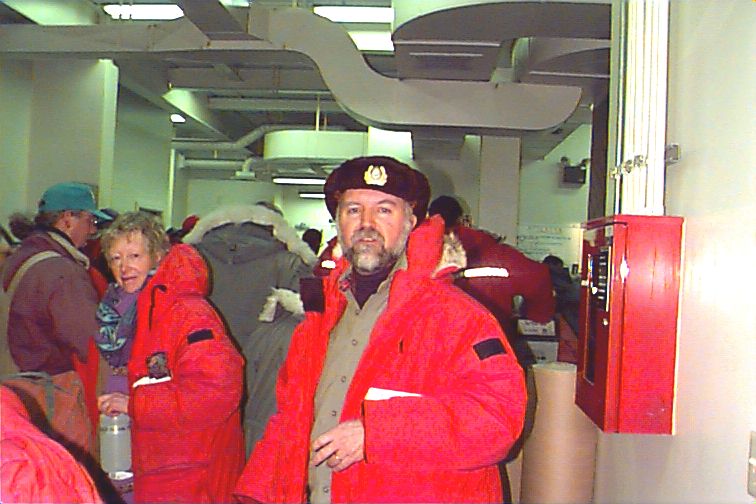
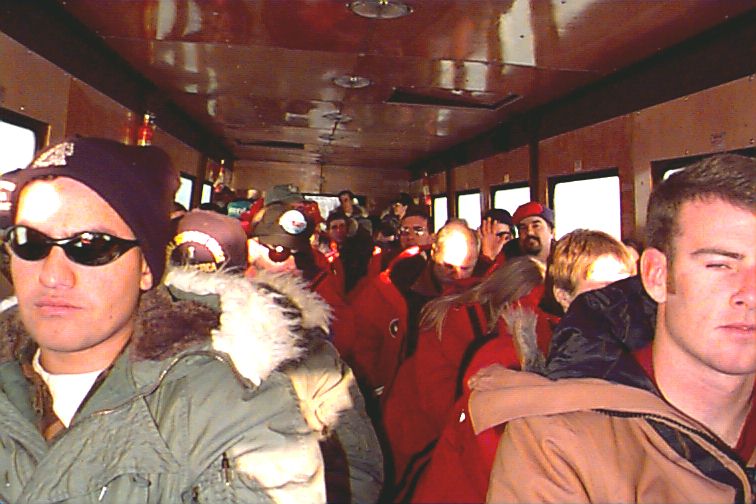
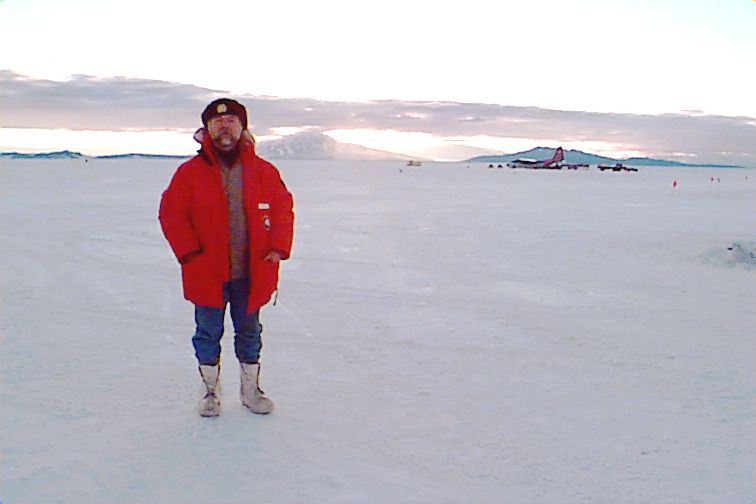
“Get all yer ECW’s on !” yelled the loadmaster. No-one could board the plane unless fully dressed for survival in the event of an emergency landing. Layers and layers and layers of zips and velcro. Outside on the ice, I was warm from the exertion but more or less comfortable, despite wearing more clothing than I had ever worn at Pole, higher by ten thousand feet and colder by 60 degrees. “Board the plane by fives !” – and by sheer bad luck, I am in the first five. No seat selection here. No seats, for one thing – just the webbing straps and canvas bases. “You! – You Sit Down There!”. I am stuffed in the middle of an inner row. *WITHOUT* my ECW’s on, there would barely be shoulder room. *WITH* our gear on, we are wedged in like toy stuffed animals being put in boxes. I gasp, and try not to move, so as not to generate any heat. The only part of my anatomy that is not covered with layers of thermal fleece and goose-down, is my nose. A dozen more unrecognizable people are added to the inner row, and I am unable to move. Even if I could stand up, a dozen pairs of quilted legs and insulated boots completely block the way to the rear of the plane and the funnel that passes for the restroom. Earplugs are tossed out like confetti: I take off my two layers of gloves, insert them, and remind myself that without adversity one can not attain sainthood. The time will inevitably pass, no matter how uncomfortable. I just hope that my bladder will last.
The flight was so awful, I shall spare the details lest re-reading this journal in the future discourages me from ever returning. The time did pass, my bladder did last, it was an ordeal of the first magnitude. I’m not sure if I slept, passed out or went into a trance: we landed at Cheech at 8 AM and were herded around by military ground staff who were grumpy from having just woken. Our belongings were tossed in a pile of identical orange bags to paw through: we took off our ECW’s, and heaped them for Return Inspection. In an instant, men in blue coveralls pushed the piles of clothing across the cement floor with brooms, and we were discharged, blinking and disoriented, into the summer civilian sky. Antarctica was gone.
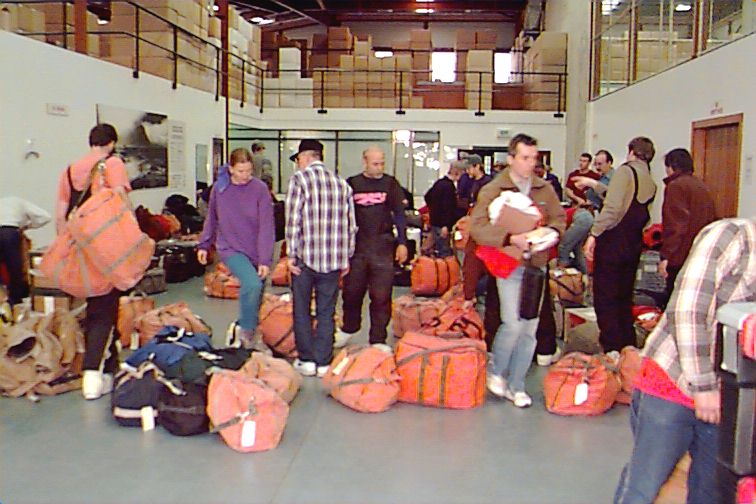
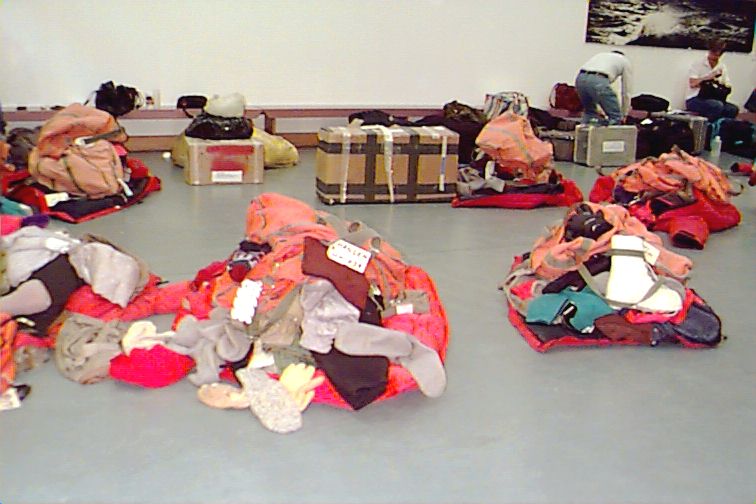
Journal Entry:
Christchurch
Friday, February 14th
The Antarctica that I experienced on this trip was a contrast of the expected and the unexpected, a dichotomy between the natural world and the organizational world of human life.
I had seen the picture books, marveled at the wonders of scenery and wildlife. I had read the tales of early sacrifice and disappointment. I had viewed the instructional videos, and had read about the frontiers of science. I was prepared for a heroic and uplifting experience.
Antarctica itself *was* astounding, indescribable, awe-inspiring. I saw a piece of ice that was as big as a part of Europe. I stood at the Geographic Pole and watched the sun go around me, felt the earth turn beneath my feet. I felt the bite of cold, the pressure of wind: I gasped for breath and saw icicles in the sea.
I met remarkable people: not leaders or visionaries or Nobel candidates, but people who washed dishes and drove Cats and shoveled snow by hand. These people were paid little more than minimum wage, put in 12-hour days when they had to, and lived in complete lack of privacy for months. They suffered the petty vagaries of favoritism and profanity, yet fulfilled their contracts. They could do it, and they did. They worked in oil and grease and diesel fumes, and were allocated two 2-minute showers per week. They bussed the dishes from the ‘power table’ in the galley where the administrators and office personnel sat. They climbed ladders and put up siding until their coveralls wore through and their faces iced over and their fingers couldn’t hold tools any more. They were stuffed into airplanes like soft cargo by the Crisp Military in their clean uniforms, worse than anything I have *ever* experienced on Aeroflot, and herded like convicts upon their return to the world of their families. Many of them will go back for more.
The image of Antarctica that is created for public consumption is one of transcendental purity. Not in a single book that I read prior to my trip did I ever see detailed mention of human life in the major settlements on the continent. The ‘Antarctic Centre’ in Christchurch features a gift shop full of politically correct items, but without a single postcard of McMurdo or Pole. The fact that Pole Station is necessarily suffused with exhaust fumes is not for public release: the orderly storage yards of McMurdo are never photographed.
Many of the aspects of life and work in Antarctica that I viewed, are immutable. The cold and bleakness at Pole are the meteorological flip side of the clarity of sky and the occasional displays of ice crystals and optical phenomena. The lack of night and stars could be predicted. The lack of privacy might be foreseen by the very astute, but an appreciation of the submarine atmosphere requires a longer stay than I had. In the corporate world in the big city, the office is left behind: at Pole, it seems as if nothing is left anywhere; in McMurdo, it seems as if nobody cares.
I hope to go back: there is more of my work to do. I look forward to meeting the subsequent staffs of people who Go There because it’s There, despite the unavoidable and the unnecessary, the natural and the human harshnesses. Perhaps the ultimate face-down of the military is to sit on the thirty-year-old airplane for eight hours, pull out your earplugs and to walk off with your head held high, slowly down the hill into the Pole Dome, and to treat everyone with respect and kindness. If I am so fortunate, I shall so try again.
Antarctica is worth the indignity, the human price that is endemic for working there. I was astounded at that which was natural, and shall try in my own small way to improve that which is the result of human activity.
I thank you for your attention, and will welcome your comments.
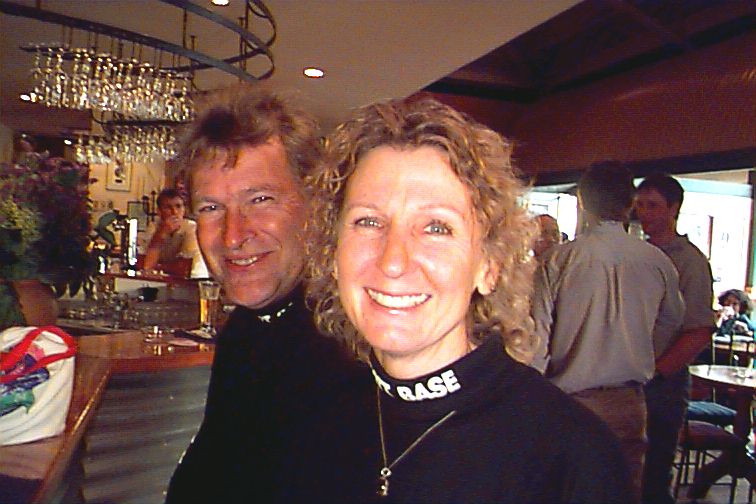
PS: Sharon Tredway met her husband in New Zealand, as she had longed for since before Thanksgiving. She is no longer a slight Materials Handler in an oily jacket who cried from exertion at 60 below zero: she is someone with Real stories to tell to her grandchildren.
My primary goals at the South Pole are to install several instruments to monitor air pollution. The National Science Foundation is sponsoring this project, because they are very interested in understanding the level of pollutants coming from the South Pole station. They are interested in this for several reasons: the maintenance of the pristine Antarctic environment, the health of the people working there, and compliance with international agreements which strictly limit the level of pollution there.
The pollution monitor which I manufacture is called The Aethalometer. It is designed to do real-time measurement of aerosol black carbon (‘BC’ or ‘EC’). The Aethalometer is an instrument that measures a pollutant species of suspended carbonaceous particulates. Aerosol Black Carbon (“BC”, or “EC” for Elemental Carbon) is a ubiquitous component of combustion emissions. It is most obvious in diesel exhaust, but it is emitted from all combustion sources together with other species such as toxic and carcinogenic organic compounds. If you’d like to read a little more about this instrument, please see the Web page of my company, Magee Scientific.
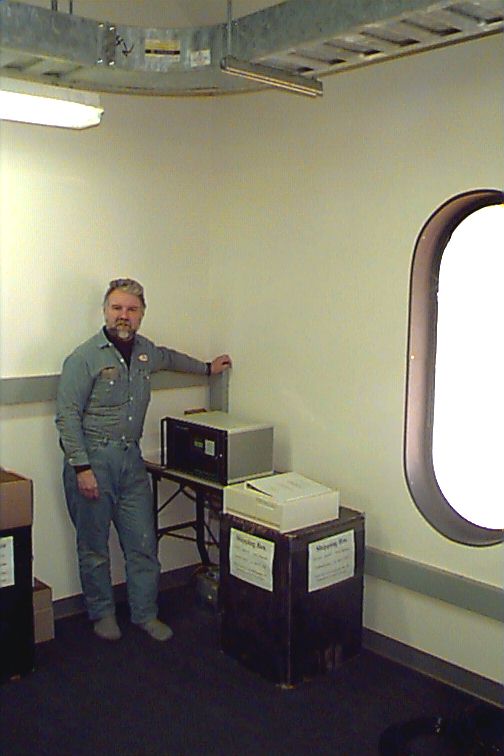
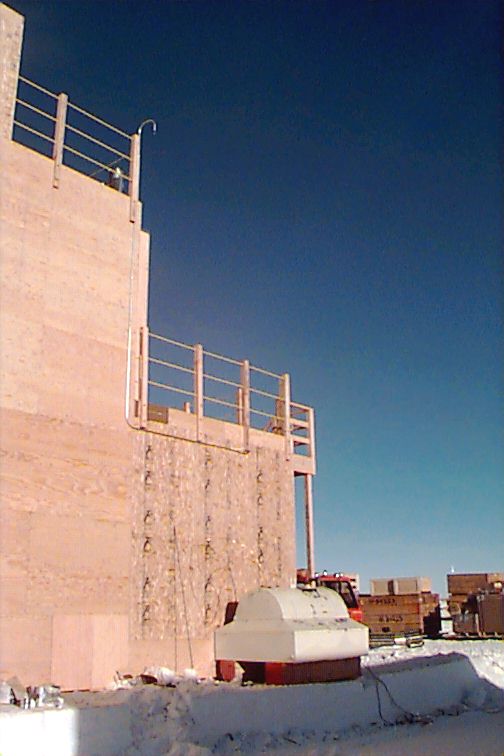
This is the Balloon Launch building. This is where my second instrument is installed – the pictures show the air inlet. The Balloon Launch building is the down-wind location, to pick up the smoke emissions from Station operations.
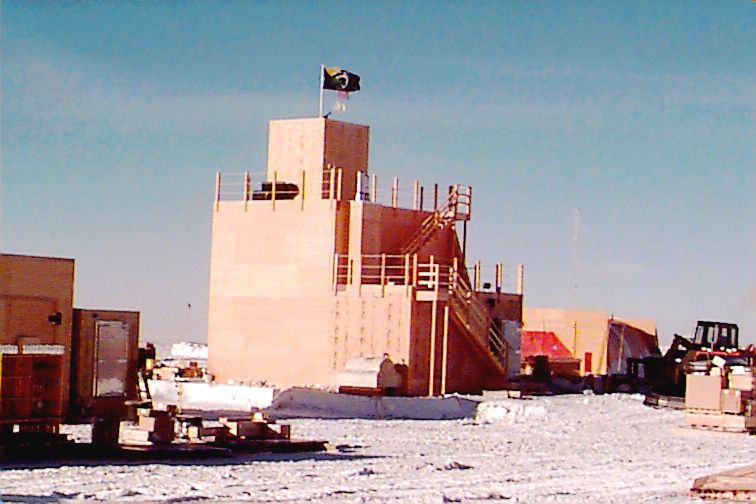
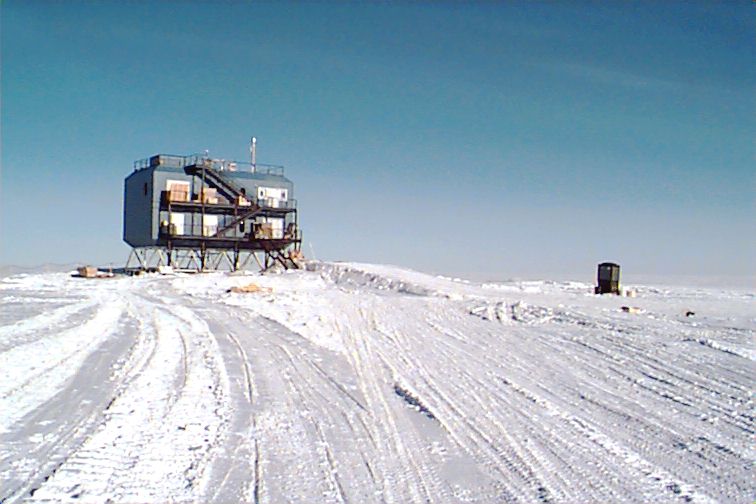
Aerosol d.o.o.
Kamniška 39A
1000 Ljubljana
Slovenia, Europe
+386 1 4391 700
Aerosol USA Corp.
10157 SW Barbur Blvd Suite 100C
Portland, OR 97219 USA
+1 510 646 1600


