

This article outlines how TCA09 complements existing Aethalometer measurements and provides additional insights.
Fine particulate matter (PM2.5) is a key air quality concern worldwide, with well-documented impacts on human health and climate. A significant share of PM2.5 consists of carbonaceous aerosols, including black carbon (BC) and organic carbon (OC).
The dominant sources of organic carbon (OC) aerosols exhibit strong regional and seasonal variability. In Europe, residential biomass burning (particularly wood combustion) is a major contributor during winter, while biogenic secondary organic aerosol dominates in summer (Ytrri et al., 2019). In North America, wildfires and other forms of biomass burning have become increasingly important sources, especially during the summer season (Ivančič et al., 2023). In Asia, organic carbon is largely influenced by a combination of agricultural biomass burning, residential fuel use, and urban anthropogenic emissions (Ivančič et al., 2025). Across all regions, secondary formation from both biogenic and anthropogenic precursors represents a substantial fraction of total OC.
Monitoring networks already use Aethalometers to measure BC and understand trends, sources, and concentration levels. Building on this established foundation, measurements can be extended with total carbon. When BC and TC are interpreted together, organic carbon can be determined under defined assumptions, providing additional insight into carbonaceous aerosols.
A practical way to expand existing Aethalometer-based monitoring is to add the TCA09. This allows monitoring agencies to preserve their current BC monitoring infrastructure, retain long-term data continuity, and expand measurement scope with minimal system changes.
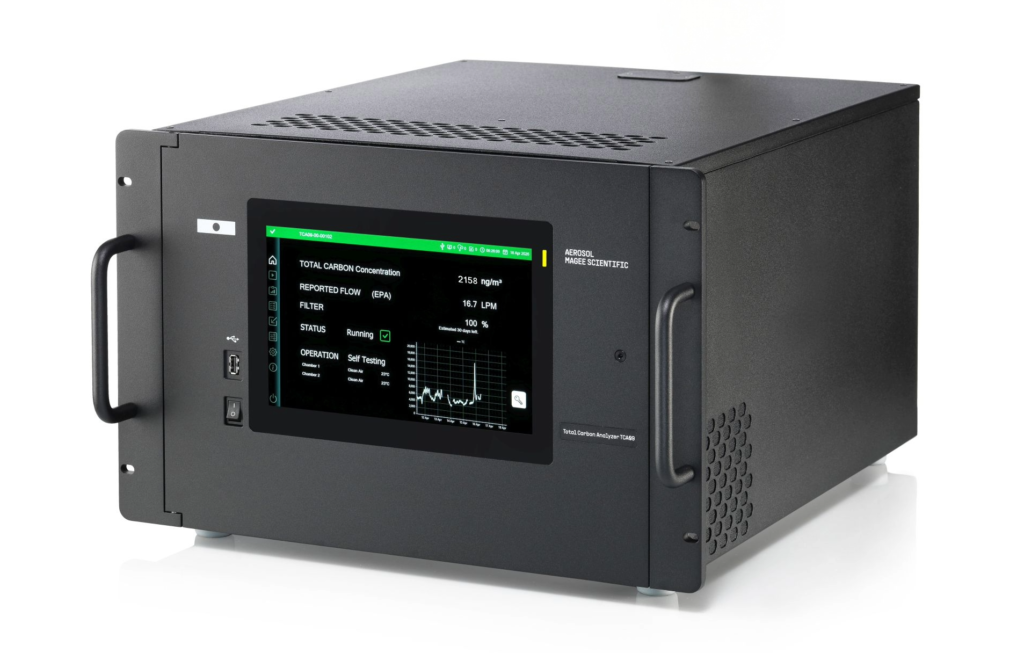
In this setup, BC is measured optically by the Aethalometer. At the same time, TC is measured in parallel by the TCA09 using an online thermal method. The measurement approach is aligned with established OC/EC standards (CEN/TR 18076), with calibration following EN 16909 procedures. This makes the system suitable for monitoring agencies that require alignment with established methodologies, while maintaining continuous and automated operation.
Combining BC and TC measurements provides a more complete understanding of carbonaceous aerosols, with TC reflecting the overall carbon load, BC its light‑absorbing fraction, and their difference enabling the estimation of organic carbon.
When these measurements are integrated within a unified system such as the Carbonaceous Aerosol Speciation System (CASS), additional analytical approaches become possible. These include multi-component modeling and carbonaceous aerosol fingerprint (CAF), supporting even more detailed interpretation of emission sources.
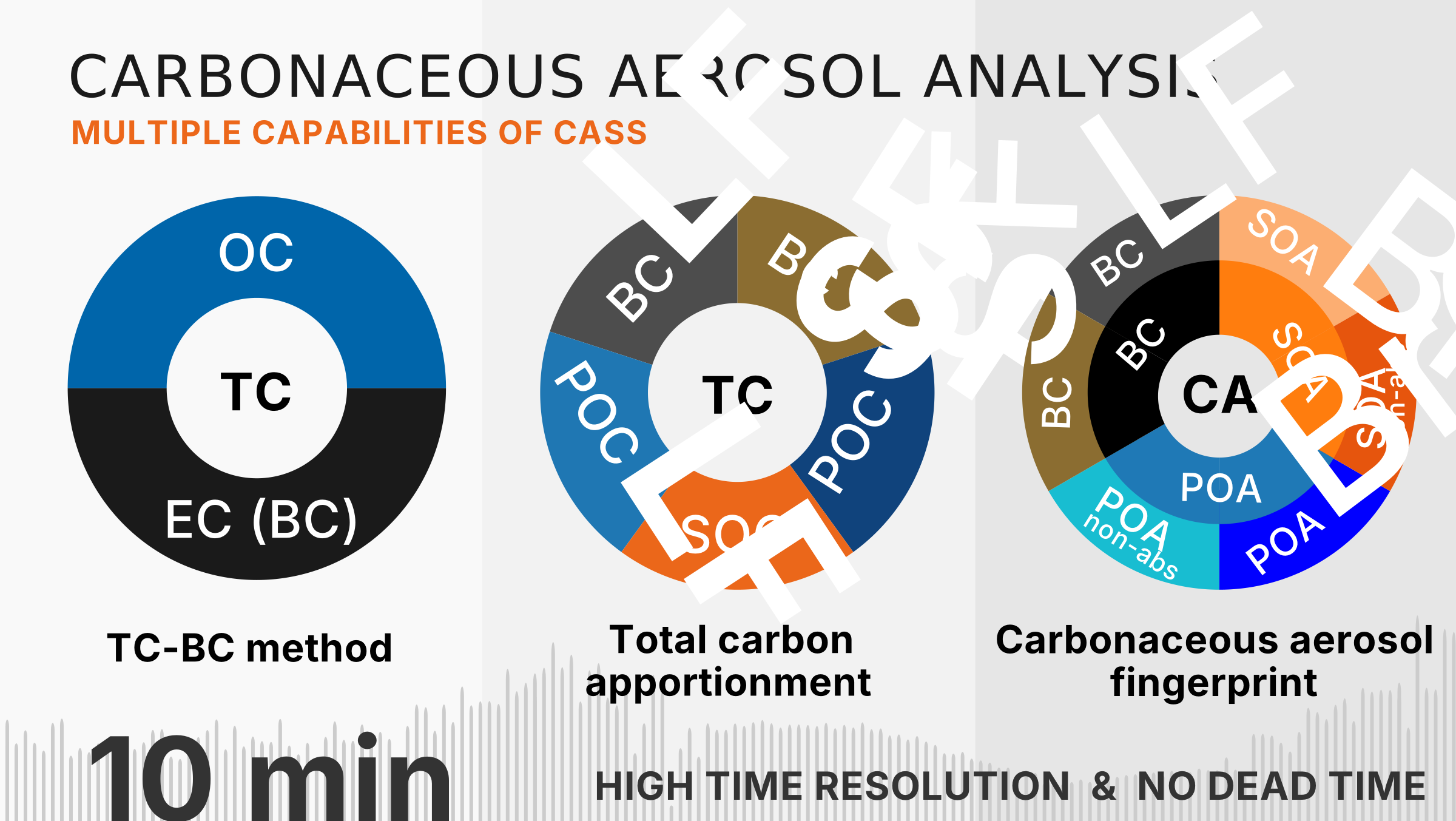
CASS combines an Aethalometer (AE36 or AE36s) with the TCA09 into a single system for real-time measurement of carbonaceous aerosols. It enables the determination of BC, BrC, TC, EC, POC, and SOC fractions. Total carbon is measured in parallel by the TCA09. The data streams are time-aligned, allowing consistent comparison and interpretation. This removes the need to combine datasets from separate instruments.
What the combining of BC and TC measurements means in practice?
High-resolution measurements allow rapid detection of transient emission events, such as traffic peaks or local combustion sources. When both BC and TC are available, it becomes possible to assess whether variations are dominated by soot-rich emissions or by broader carbonaceous aerosol sources.
BC measurements already support differentiation between combustion sources. Adding TC provides a broader perspective, particularly when combined with source apportionment models, to obtain for example primarly organic carbon (POC), and secondary organic carbon (SOC) fractions.
Offline OC/EC methods require filter collection and laboratory analysis, introducing delays and temporal gaps. Online TC measurements provide continuous data coverage, improving temporal consistency.
A combined system simplifies setup and reduces the need for extra processing. It supports routine monitoring with minimal manual work.
For monitoring agencies, integration into existing infrastructure is a critical factor.
TCA09 is designed to operate alongside Aethalometers within the same ambient sampling environment. The instrument uses ambient air as a carrier gas and does not require specialty gases or fragile auxiliary components, simplifying deployment in both fixed and semi-mobile monitoring stations.
The two instruments can be easily connected using one cable.
Long-term operation is supported through autonomous measurement cycles and extended filter lifetime, reducing on-site maintenance requirements.
The transition from BC-only monitoring to combined BC-TC measurement is not only a technical extension, but also a shift in monitoring capability.
With BC and TC combined, monitoring agencies gain access to:
When extended further through systems such as CASS, this approach also supports source-resolved analysis and advanced workflows for research and regulatory applications.
Aethalometers remain a central tool in air quality monitoring, providing reliable measurements of black carbon. By pairing TCA09 with Aethalometers such as AE33, AE36, and AE36s, monitoring networks can easily integrate total carbon measurements into existing setups. This provides additional insight into carbonaceous aerosols while supporting continuity and improved data interpretation. Together, they provide a more complete picture of air quality and PM2.5 composition.
Find out more about TCA09 and CASS.
Build on existing BC measurements
Aethalometers already provide reliable black carbon (BC) data. Adding total carbon extends existing monitoring setups without changes to infrastructure.
Determine organic carbon
By combining total carbon (TC) and BC measurements, organic carbon (OC) can be determined, providing additional insight into carbonaceous aerosols.
Continuous online measurement
TCA09 enables continuous, real-time TC measurements, supporting consistent data collection without delays from laboratory analysis.
Improved data interpretation
Combined BC and TC data provide a clearer understanding of aerosol composition and support interpretation of emission sources.
Integrated system capability
In CASS, Aethalometer and TCA09 measurements are time-aligned, enabling direct comparison without the need to merge separate datasets.
Simple integration and operation
The system integrates into existing monitoring setups and supports routine operation with minimal manual work.
Sources:
Aerosol d.o.o.
Kamniška 39A
1000 Ljubljana
Slovenia, Europe
+386 1 4391 700
Aerosol USA Corp.
10157 SW Barbur Blvd Suite 100C
Portland, OR 97219 USA
+1 510 646 1600