

Instruments deployed in fixed monitoring stations are increasingly used by diverse teams with different responsibilities. These range from routine operation and quality control to scientific analysis and communication with decision makers.
As monitoring data are used across more functions within an organization, instrumentation must support a broad range of operational and analytical needs without compromising data quality.
This diversity of users and use cases makes it essential that instrumentation deployed in monitoring stations is deliberately designed around the practical realities of those who rely on it every day. Aethalometer AE36 was developed specifically to address these operational, regulatory, and scientific demands within modern monitoring networks.
In monitoring networks that need to distinguish between different pollution sources for effective mitigation and health‑relevant reporting, black carbon (BC) provides insight not available from particulate mass metrics alone.
AE36 measures BC, a light‑absorbing component of particulate matter directly linked to combustion. It can separate BC contributions from traffic (liquid fuels) and biomass burning (solid fuels) in real time. While PM₂,₅ or PM₁₀ describe particulate mass, BC provides complementary, source‑relevant information that is critical for interpreting air quality data in monitoring networks.
Some monitoring institutions operate in environments where routine air quality monitoring and applied research are carried out within the same station. In these environments, instruments must support both standardized operation and scientifically meaningful interpretation.
A key requirement is data continuity – ensuring that measurements remain consistent, comparable, and usable across sites and over time.
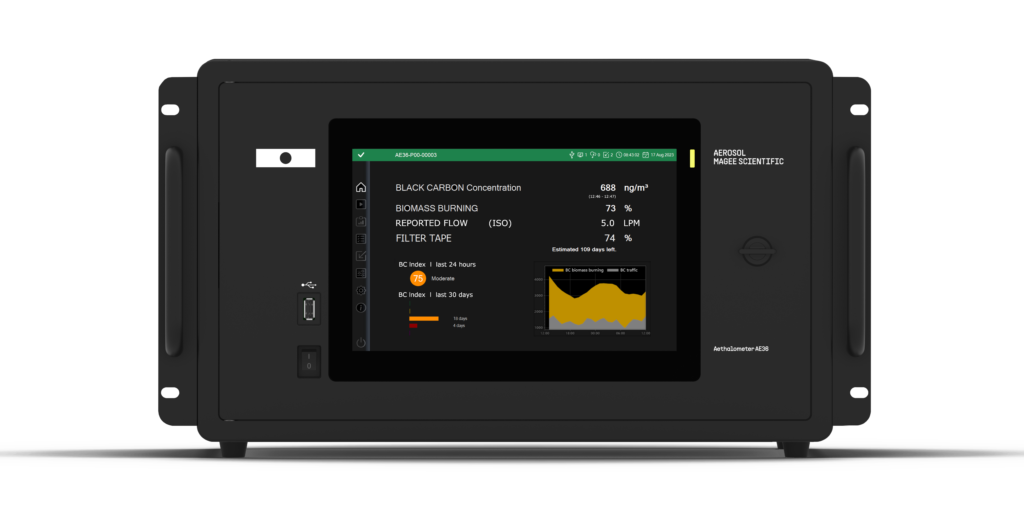
AE36 was designed to meet the needs of monitoring agencies, station authorities, and institutions where routine monitoring and applied research are combined within the same station. Its design reflects the operational constraints of monitoring networks, in which long‑term data continuity, comparability across sites, and reduced manual intervention are critical.
Built‑in Dual Spot technology compensates for filter loading effects in real time, providing stable BC data without the need for routine post‑processing. This is an important requirement for agencies often struggling with operational overload.
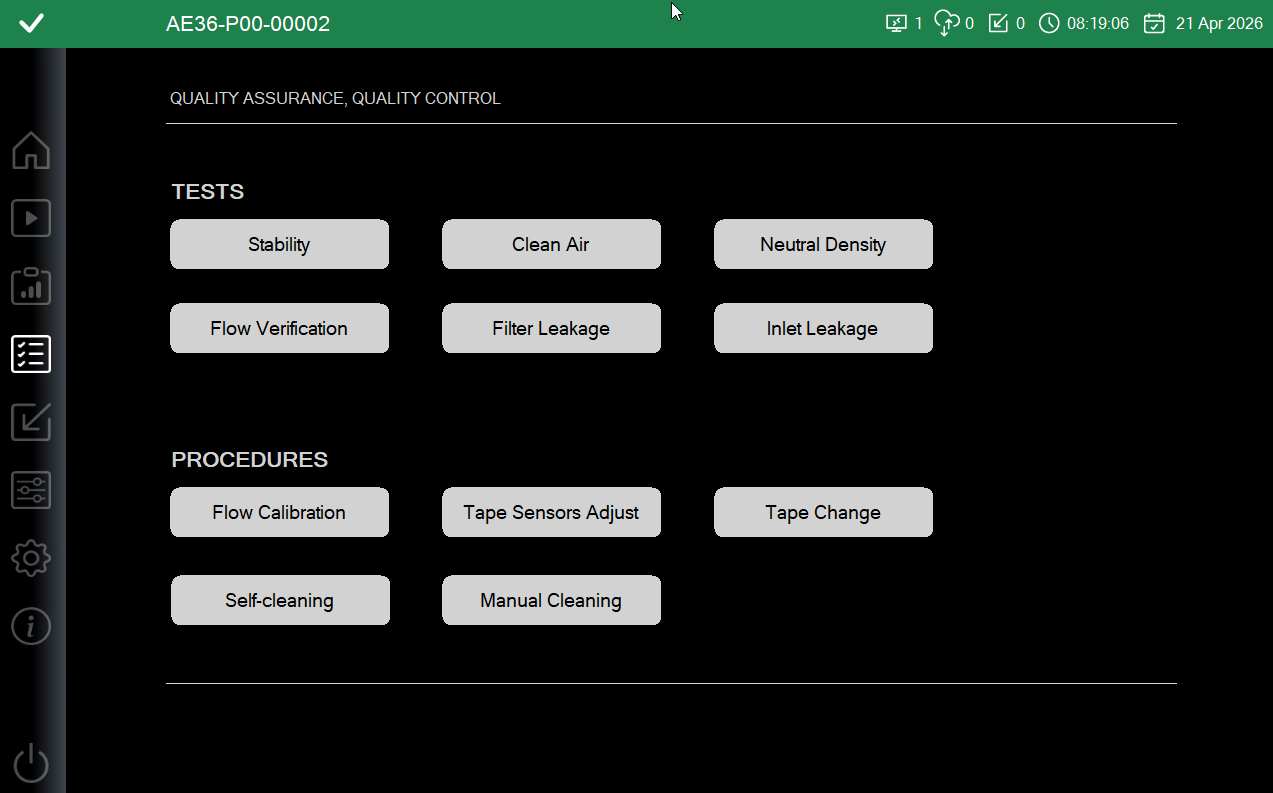
Data integrity is ensured through built‑in quality assurance and quality control (QA/QC) procedures. These include stability test, clean air test, flow verification, optical validation (neutral density test), and leakage checks.
These routines support consistent and defensible long-term monitoring data.
Monitoring networks typically operate multiple instruments across distributed sites and rely on central data handling to ensure consistency and comparability. A key requirement for these networks is that all measurement data can be aggregated on their own time base, allowing information from different instruments to be combined, and evaluated together.
AE36 is designed as a plug‑and‑play instrument, enabling rapid deployment and immediate use without complex configuration. This supports consistent installation and operation across monitoring sites and reduces variability introduced during setup. For network operators, consistency at this stage is an important foundation for repeatable measurements.
Remote Access System (RAS) enables remote monitoring, control, and data download from AE36, supporting data continuity by helping detect issues such as inlet blockages or sampling problems as soon as they occur.
Continuous visibility of instrument status and measurement behavior allows operators to quickly identify irregularities, reducing downtime and preventing unnoticed data gaps. In long-term monitoring, this contributes to more complete and reliable datasets.
Most monitoring sites are inherently site‑specific, with local constraints related to environment, infrastructure, or accessibility. While these individual requirements cannot be eliminated, AE36 reduces the need for frequent manual maintenance across sites. Low maintenance is supported by features such as the 20 m filter tape and built-in self-cleaning procedure, reducing site visits and supporting stable long-term operation.

Fewer manual interventions reduce operational variability and support improved repeatability over time, especially in networks managing many stations simultaneously.
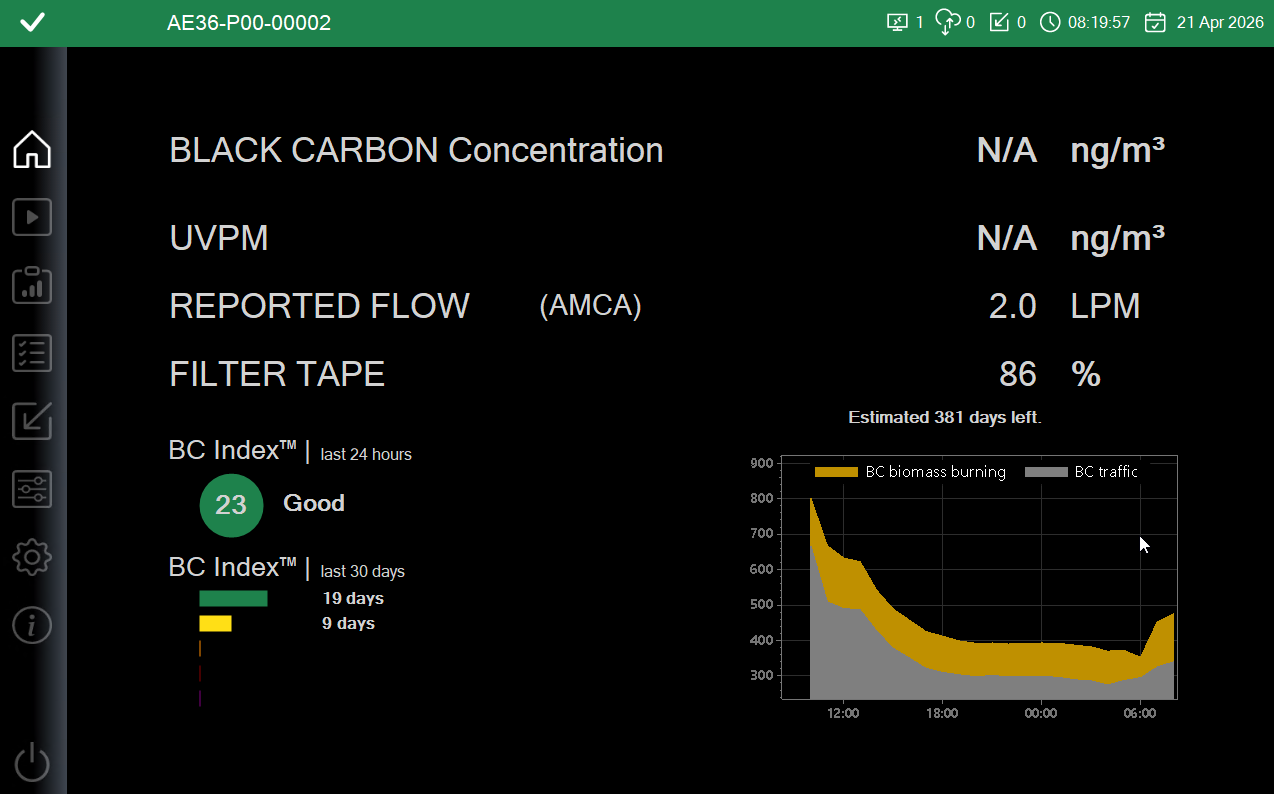
For technicians and network operators, clear status indicators and user‑friendly data handling are essential for efficient daily work. The AE36 interface combines intuitive screens, real‑time graphs, and clear visual status indicators. This allows users to quickly identify when something is not operating as expected.
To support communication beyond technical expert users, AE36 also provides a Black Carbon (BC) index, translating BC concentrations into an intuitive indicator aligned with air‑quality index principles.
Data can be easily exported for further analysis, helping reduce response times to operational issues and limiting the influence of human factors on overall data quality.
For many monitoring agencies, the primary reporting parameters are BC concentration and source apportionment rather than aerosol optical properties alone. In this context, the Ångström exponent is used as a controlled parameter supporting source apportionment. It helps distinguish between traffic‑related and biomass‑burning‑related BC (e.g. biomass burning %), rather than being used as a standalone optical metric.
This balance between flexibility and control is essential for organizations that combine monitoring and research within the same operational context.
Find out more about Aethalometer AE36.
Designed for real monitoring environments
AE36 is designed for monitoring agencies, station authorities, and institutions where routine monitoring and applied research are carried out within the same station.
Supports multiple user roles
The instrument supports operators, technicians, analysts, scientists, and decision‑makers without compromising data quality or long‑term consistency.
Data continuity
Plug‑and‑play installation, remote access, real‑time Dual Spot compensation, and early detection of issues minimise the risk of unnoticed data loss.
Reduced manual maintenance
Extended filter tape and self‑cleaning reduce site visits and operational variability, especially in distributed monitoring networks.
Controlled flexibility for interpretation
BC concentration, source indicators (BB%), and controlled Ångström settings support consistent interpretation across monitoring sites.
Aerosol d.o.o.
Kamniška 39A
1000 Ljubljana
Slovenia, Europe
+386 1 4391 700
Aerosol USA Corp.
10157 SW Barbur Blvd Suite 100C
Portland, OR 97219 USA
+1 510 646 1600