THE AETHALOMETER

The world’s most trusted
black carbon monitor
Designed for real-time measurements of the local and global impacts of light-absorbing aerosols. Used from the Sahara Desert to the South Pole, Tibet to Brazil, New York City to the Mauna Loa Observatory in Hawaii.

Reliable data helps us clean the air.

First developed by Tony Hansen in 1979, the Aethalometer has become the benchmark instrument for measuring black and brown carbon aerosols, delivering reliable data from all over the world.
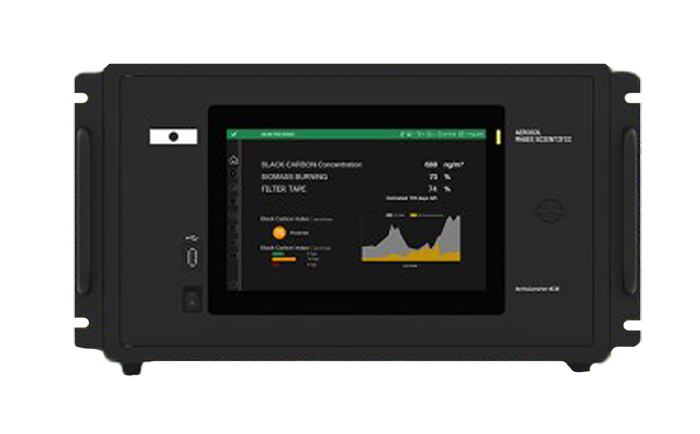
The Aethalometer is the globally recognized gold standard for real-time black carbon measurement. With over 40 years of proven reliability, it routinely delivers high-quality data from thousands of monitoring stations; and has been used in countless scientific studies. Its patented DualSpot technology, real-time source apportionment, and robust engineering make it the trusted choice for researchers and environmental monitoring agencies . Backed by exceptional technical and scientific support, the Aethalometer offers peace of mind and consistent data continuity, making it an essential part of both scientific research and air-quality monitoring projects anywhere in the world.
Built to be rugged, logical and reliable, the Aethalometer can be used easily in a wide range of applications. It integrates seamlessly into research or monitoring installations. Real-time data display, automatic filter loading compensation, and built-in source apportionment eliminate the need for post-processing of data: saving time and operational effort. Whether used for urban pollution tracking, academic research, or compliance reporting, the Aethalometer delivers immediate, actionable data and is an essential tool in the understanding of air pollution.
Thousands
of Aethalometers deployed worldwide across all 7 continents!
From deserts to mountaintops
Aethalometers measure black carbon everywhere – from the Sahara Desert to the South Pole, from the streets of New York City to the mountaintop of Mauna Loa in Hawaii, and from the rainforests of Brazil to the heights of Tibet. The Aethalometer is designed to deliver data in the world’s most demanding environments and everywhere in between.

The Aethalometer's journey: from concept to global impact

The Aethalometer was conceived in a research laboratory in 1979 and developed for general use in the 1980s. It revolutionized the real-time measurement of black carbon aerosols (“soot particles”) in the atmosphere. Initially used by researchers at remote locations, it quickly became a trusted tool in general environmental science. Over the decades, it evolved with multi-wavelength capabilities, advanced algorithms, and real-time data reporting. Its long-term, precise measurements have helped bring the measurement of carbonaceous aerosols to the forefront for climate scientists, health organizations, and air quality specialists.
These measurements have shown that black carbon, a component of fine particulate matter (PM2.5), is a major threat to both human health and the climate. The Aethalometer’s history reflects a legacy of innovation and a global commitment to understanding and improving air quality.
FIND OUT MORE
1977
Optical attenuation method developed
Work in the 1970s at the Lawrence Berkeley National Laboratory established the quantitative relationship between the optical attenuation of a deposit of particles on a fibrous filter and the carbon content.
1979
Birth of the Aethalometer
The Aethalometer was first conceptualized by Anthony D. A. Hansen in Berkeley. The next years saw several prototypes in development.
1980
First field tests, first publication
The Aethalometer was utilized in an EPA visibility study at Houston in 1980, which produced the first real-time data chart of Black Carbon concentrations in ambient air.
1984
Aethalometer at remote locations
Measurements of Black Carbon started at remote locations as tracer for long-range atmospheric circulation.
1984
First airborne measurements
The instrument was first flown on board a NOAA research aircraft in the Arctic in 1984, and, coupled with previous ground-level work, it showed that the Arctic haze contains a strong component of soot.
1986
Magee Scientific Corp. founded in Berkeley
Anthony D. A. Hansen founded Magee Scientific Corporation.
1988
Black Carbon recognized for the adverse health effects
Researchers begin to explicitly identify Black Carbon as a tracer for diesel exhaust particles in the atmosphere, marking a pivotal moment in linking Black Carbon to adverse health effects associated with diesel emissions.
1996
Manufacturing starts in Slovenia
In 1995, production was transferred to Europe through OEM agreement. In 1997, the basic AE16 Aethalometer measuring Black Carbon at 880 nm was joined by models AE22 and AE31 offering optical analysis at additional wavelengths.
2000s
Recognition of Black Carbon for climate change forcing
Several studies reveal that airborne soot significantly heats the atmosphere by absorbing sunlight. In 2007 The Intergovernmental Panel on Climate Change (IPCC) report includes, for the first time, estimates of the direct radiative forcing of Black Carbon from fossil fuel emissions.
2007
Aerosol Co. founded in Slovenia
In 2007, the company “Aerosol” was established in Ljubljana, Slovenia, to concentrate exclusively on the science, technology, and commercialization of instrumentation for carbonaceous aerosol measurements.
2009
First-ever pocket Black Carbon meter
Aerosol and Magee Scientific developed the first-ever pocket meter for measuring personal exposure to Black Carbon. It was later commercialized by AethLabs.
2011
Popular Aethalometer AE33 released
In 2012, the Model AE33 was released after extensive development and testing in conjunction with leading research institutes in Europe. This incorporates scientific and technical advances.
2012
WHO and US EPA recognize health and climate impacts of Black Carbon
WHO's comprehensive assessment of Black Carbon health effects was published, highlighting its association with cardiopulmonary morbidity and mortality. Similarly, the EPA's detailed research into Black Carbon health and climate. impacts was also released in 2012.
2014
US EPA, ETV approval of Aethalometer AE33
EPA's Environmental Technology Verification, created in 1995, to help accelerate the entrance of new environmental technologies into the domestic and international marketplaces. In 2014 Aethalometer AE33 was approved by this program.
2016
Dual Spot patent
DualSpot measurement method, used exclusively in Aethalometers, was patented in 2016. This, and other patented solutions, make Aethalometers a gold standard for Black Carbon monitoring.
2020
Release of portable Aethalometer AE43
AE43 introduced to cater for specific scientific and monitoring needs, like vertical profiling, emission testing, health effects research, mobile mapping, and field measurements at remote locations.
2023
Release of the new Aethalometers AE36 and AE36s
Continuing the success story of AE33, the AE36 and AE36s incorporate new capabilities for more extensive monitoring of Black Carbon and unprecedented research.

FAQ

Black carbon (BC) is a primary pollutant produced by the incomplete combustion of fuel. Its association with toxic and carcinogenic compounds makes it the pollutant species most associated with adverse health effects. Its absorption of light makes it a major climate forcing agent, second only to CO2. Unlike CO2, emissions of which are directly related to the carbon content of the fuel, the emissions of BC can differ by orders of magnitude from one combustion source to another, depending on the quality of combustion. Consequently, the emission of BC cannot be predicted: it has to be measured.

The Aethalometer collects aerosol particles on a spot on a filter tape. The spot is illuminated from one side, and the transmitted light is measured on the other side. A blank, unloaded portion of the filter is used as a reference. The optical attenuation, ATN, is a measure of light absorption and is directly proportional to the amount of material deposited on the spot. The rate at which ATN increases is proportional to the rate of accumulation of absorbing material. Knowing the sample air flow rate, the concentration in the air stream is calculated. This analysis is performed at multiple optical wavelengths since some aerosol species may have enhanced optical absorption at shorter wavelengths.

Great question - How does the Aethalometer measure only black carbon, while the ambient air is a mixture of many pollutants such as greenhouse gases, sulphates, nitrates, CO2, etc.?

The Aethalometer collects aerosols on a filter tape – but gases pass through it. Aerosol black carbon is the only species with a very strong optical absorption at 880 nm (infra-red light).  Some compounds of organic aerosols – such as brown carbon and biomass smoke – may absorb light more strongly at shorter wavelengths.  The Aethalometer analyses simultaneously at multiple wavelengths and can discriminate diesel emissions from wood smoke.

The filter loading effect refers to the progressive reduction in measurement sensitivity as aerosol particles accumulate on the filter. As the filter darkens, the optical path is altered, leading to a non-linear underestimation of black carbon (BC) concentrations over time.

To address this, the Aethalometer employs a patented DualSpot technology developed by Aerosol Magee Scientific. This method uses two parallel filter spots exposed to different flow rates. By continuously comparing the optical attenuation rates between the two spots, the instrument can dynamically quantify and correct for the loading effect in real time.

This correction is further refined through embedded software algorithms that calculate a compensation parameter (commonly referred to as k), which reflects the degree of non-linearity introduced by particle accumulation. This approach ensures more precise, stable, reliable black carbon measurements, even during long-term unattended operation or in environments with high particulate concentrations.

Accurate correction of the loading effect is essential not only for reliable black carbon quantification but also for correct source apportionment, especially when distinguishing between fossil fuel and biomass burning emissions.

In summary:

The Aethalometer offers artifact-free measurements (DualSpot), detailed aerosol characterization (multi-wavelength analysis), and reliable operation, making it the preferred choice for both research and long-term BC/BrC monitoring studies. Its design directly addresses issues such as filter-loading errors and environmental instability, which commonly plague other BC instruments.

Further details:

  1. PRECISE, REAL-TIME MEASUREMENTS

The Aethalometer uses patented DualSpot technology to automatically correct for filter-loading effects in real time. This delivers precise black carbon (BC) data even at high concentrations without the need for post-processing.  High-quality data is essential for accurate source apportionment.

  1. SOURCE APPORTIONMENT, MULTI-WAVELENGTH ANALYSIS

With seven or nine optical wavelengths (from 340 to 950 nm), the Aethalometer can distinguish between different sources of carbonaceous aerosols in real time - – such as BC from diesel exhaust and BrC from biomass burning. 

  1. RELIABLE IN ALL ENVIRONMENTS, FOR ALMOST HALF A CENTURY

The Aethalometer is built for field use, with low power requirements and proven durability in all conditions. Some instruments have been in service for decades.

  1. REAL-TIME, HIGH-RESOLUTION DATA

The Aethalometer provides real-time data with time resolution as fast as one second. This allows users to monitor rapid changes in air quality or to use the instrument for specific applications, such as emission factors, mobile measurements, monitoring wildfire smoke, etc.

  1. EASY TO USE AND MAINTAIN

Features like automatic QA/QC, built-in diagnostics, and remote operation make the Aethalometer simple to deploy and maintain, whether in the lab or the field.

  1. PROVEN AND SUPPORTED BY SCIENCE

Aethalometer data have been used in more than 10,000 scientific studies (Google Scholar) in a wide variety of applications. With five decades of experience, we know more about black carbon than anyone else: we’re able to answer any question our users may have, from practical setup to advanced scientific support.

HEADQUARTERS

Aerosol d.o.o.
Kamniška 39A
1000 Ljubljana
Slovenia, Europe
+386 1 4391 700

USA Office

Aerosol USA Corp.
10157 SW Barbur Blvd Suite 100C
Portland, OR 97219 USA
+1 510 646 1600