

Air quality discussions often focus on particulate matter mass concentrations such as PM₂.₅ or PM₁₀. While these metrics are important, they mask a critical reality: not all particles are equally harmful to human health or the climate.
The chemical composition of particulate matter, particularly its carbonaceous components, largely determines its toxicity, radiative impact, and sources. Among these components, black carbon (BC), brown carbon (BrC), or organic carbon (OC), play an outsized role that remains insufficiently addressed in routine air quality monitoring.
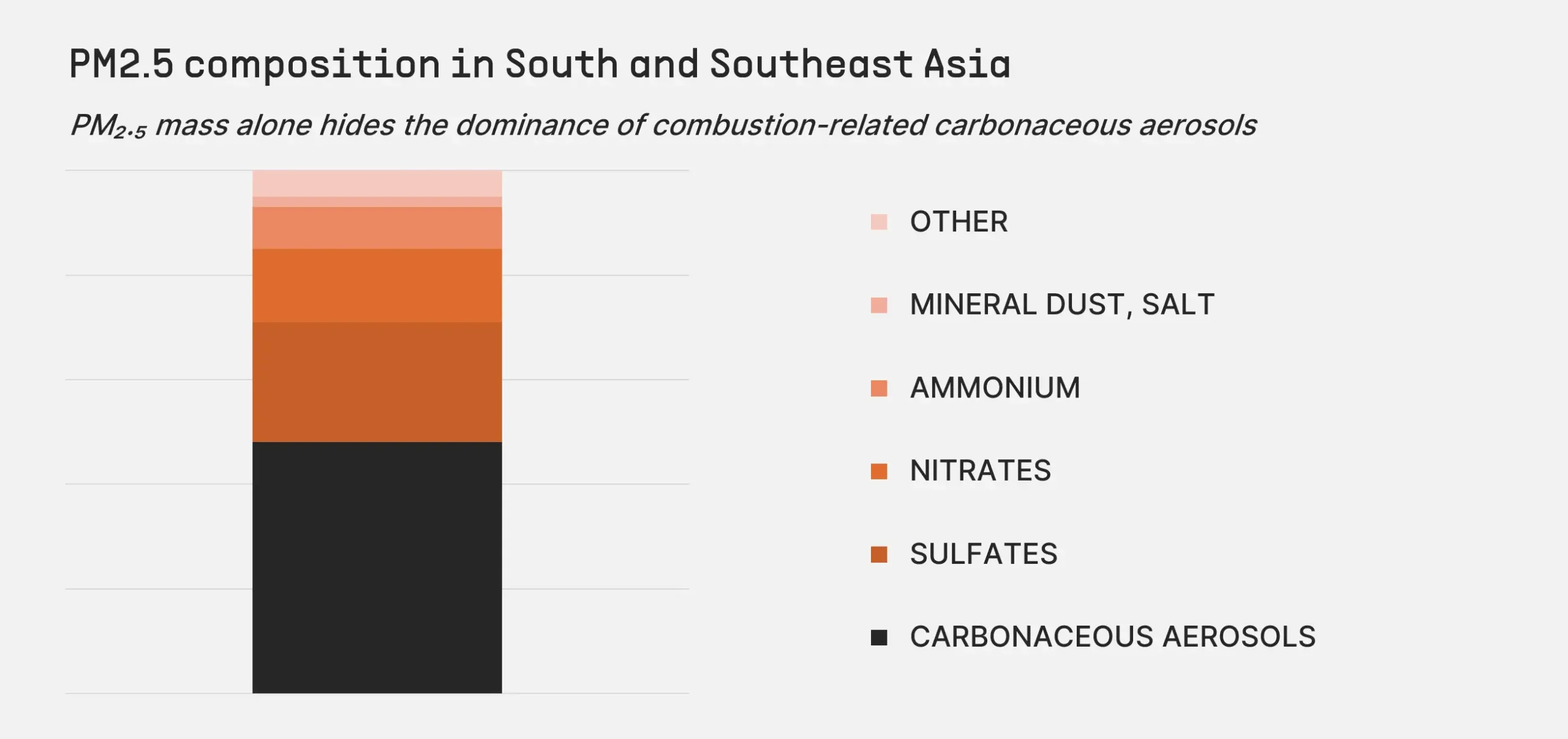
Representative composition of PM₂.₅ in South and Southeast Asia, illustrating the dominant role of carbonaceous aerosols.
Observations presented at AAC 2025 and in regional field studies consistently show that carbonaceous aerosols (= organic and black carbon) often account for more than half of PM₂.₅ mass, with strong regional and seasonal variability.
This message was strongly reinforced at the Asian Aerosol Conference (AAC) 2025 in Mumbai, where scientists and practitioners from across South and Southeast Asia gathered to discuss the region’s most pressing aerosol challenges.
A consistent theme across sessions was that carbonaceous aerosols dominate PM₂.₅ mass in the region, with regional and transboundary sources often accounting for the majority of observed pollution, rather than emissions confined to city boundaries.
Black carbon is a primary product of incomplete combustion from diesel engines, residential solid fuel use, open biomass burning, and some industrial processes.
It is both a potent climate forcer – second only to carbon dioxide in terms of near-term warming influence, and a well-established health risk due to its ability to penetrate deep into the respiratory system.
South and Southeast Asia experience some of the highest ambient BC concentrations globally, driven by a combination of dense population, widespread biomass use, and seasonal agricultural burning.
Despite this, BC is rarely measured systematically outside of research campaigns.
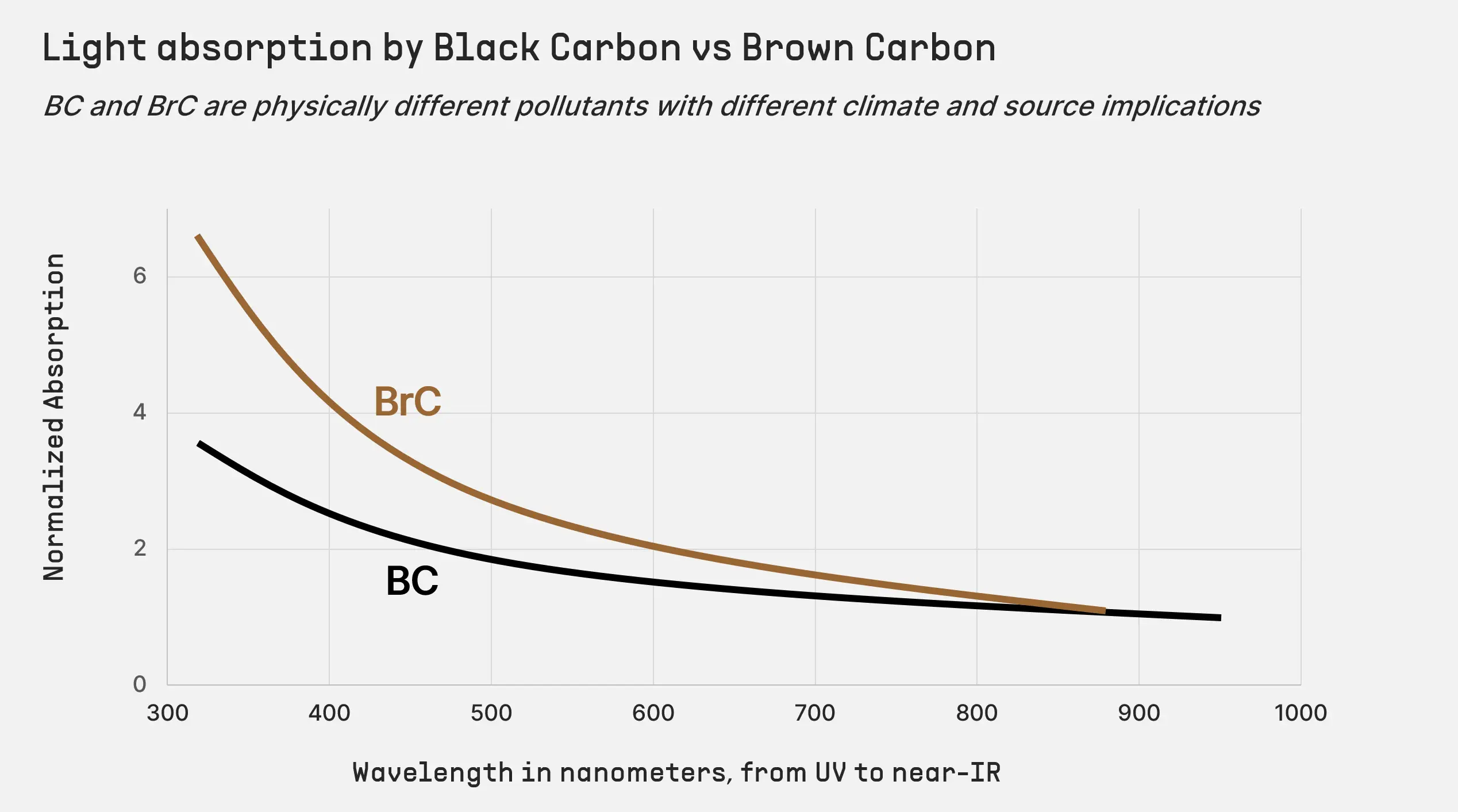
Spectral absorption characteristics of black carbon (BC) and brown carbon (BrC).
While BC absorbs broadly across the visible and infrared spectrum, BrC absorbs primarily at shorter wavelengths. Multi-wavelength optical measurements enable differentiation between these components in real time.
Black Carbon (BC)
Brown Carbon (BrC)
Even more striking at AAC 2025 was the emphasis on brown carbon and organic carbon. Multiple presentations highlighted that in many Indian and regional environments, organic aerosols represent the largest fraction of PM₂.₅ mass.
Brown carbon, a light-absorbing subset of organic carbon, contributes to atmospheric warming and visibility degradation while remaining poorly constrained in inventories and regulations. Unlike black carbon, BrC absorbs strongly at shorter wavelengths, making it both a climate-relevant and diagnostically important component of particulate matter.
From a health perspective, this distinction is critical. Evidence discussed at the conference showed that the oxidative potential of particulate matter – a metric increasingly linked to adverse health outcomes – is often dominated by organic carbon rather than by inorganic species or total particle mass alone.
In practical terms, this means that two locations with similar PM₂.₅ mass concentrations may pose very different health risks depending on the relative contributions of BC, BrC, and other organic compounds.
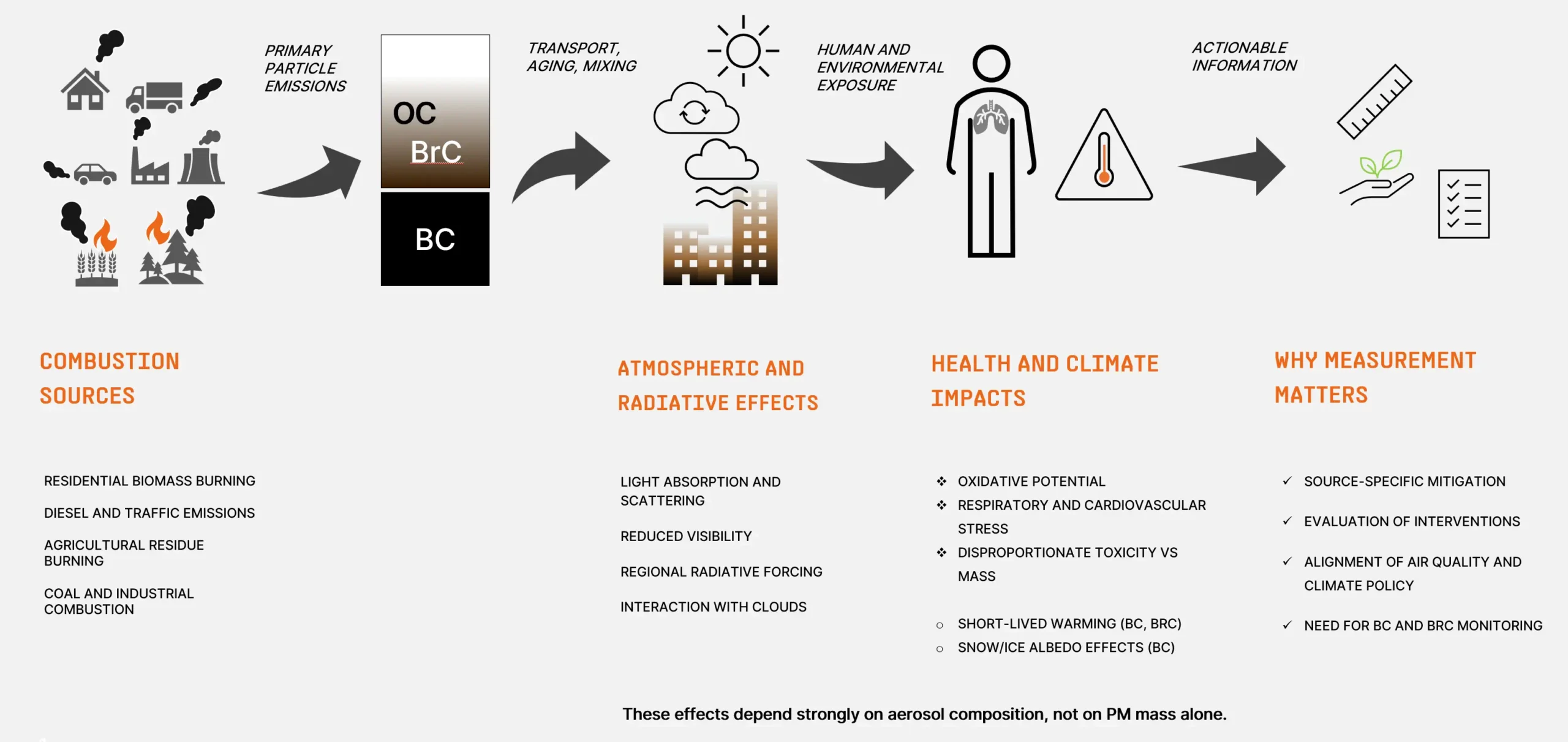
From emissions to impacts: why aerosol composition matters.
Combustion sources emit carbonaceous particles with distinct optical, chemical, and health‑relevant properties. Black carbon, brown carbon, and organic carbon undergo atmospheric processing that determines their climate forcing, oxidative potential, and exposure pathways. Measuring these components – rather than PM mass alone – provides actionable information for air quality management and climate‑health co‑benefits.
Despite their importance, BC and BrC remain largely invisible in regulatory air quality networks. Most monitoring systems focus on gravimetric mass and criteria gases, which are insufficient to characterize combustion-related pollution or to support targeted mitigation strategies. Without routine measurements of BC and BrC, policymakers lack the evidence needed to identify dominant sources, evaluate interventions, or assess co-benefits for climate and health.
Traditional air quality metrics report how much particulate matter is present. Carbon measurements explain what it is and where it comes from.
What real-time BC and BrC data enable:
Policy relevance:
This is why recent regulatory developments, such as the 2024 European Ambient Air Quality Directive, explicitly recognize black carbon as a component of concern, moving beyond PM mass toward impact-oriented regulation.
Addressing this gap requires measurements that are both time-resolved and composition-sensitive. Real-time, multi-wavelength optical methods allow black carbon to be quantified while also providing information on brown carbon through its wavelength-dependent absorption. Such approaches have become standard in atmospheric research and are increasingly being deployed in operational networks, enabling continuous source apportionment and improved exposure assessment.
Importantly, policy momentum is beginning to reflect this scientific understanding. In Europe, the revised Ambient Air Quality Directive adopted in 2024 formally recognizes black carbon as an air-quality-relevant component, encouraging Member States to incorporate BC measurements alongside traditional pollutants. This represents a significant shift from mass-only metrics toward composition-aware air quality management.
India’s Mission Mausam provides a timely and powerful framework for strengthening atmospheric observations beyond traditional meteorological parameters. The Mission emphasizes enhanced atmospheric chemistry measurements, high‑frequency observations, improved air‑quality forecasting, and impact‑based decision support.
These activities are led by the India Meteorological Department (IMD), with research and process understanding supported by the Indian Institute of Tropical Meteorology (IITM) and data assimilation and modelling advanced by the National Centre for Medium‑Range Weather Forecasting (NCMRWF). At the same time, the Central Pollution Control Board (CPCB) and State Pollution Control Boards are identified beneficiaries of Mission Mausam outputs, creating a direct pathway from advanced observations to regulatory and policy applications.
In this context, integrating real‑time, composition‑aware measurements capable of resolving black carbon (BC), brown carbon (BrC), and major carbonaceous aerosol fractions represents a natural extension of Mission Mausam’s observational mandate, strengthening the link between emissions, atmospheric processes, exposure, and impacts within a unified national framework.
Mission Mausam provides a national framework for advancing aerosol process understanding while strengthening the evidence base for air quality management.
Measurements of black and brown carbon:
Integrating BC and BrC into Mission Mausam observations directly links emissions, atmospheric processes, and impacts to regulatory and mitigation actions.
Ultimately, improving air quality in South and Southeast Asia, not just India, requires moving beyond PM mass alone toward a more meaningful characterization of particulate pollution. Measuring black carbon and brown carbon is not an academic exercise; it is essential for protecting public health, mitigating climate impacts, and designing effective, evidence-based policies. The science is clear, the tools are available, and the policy precedent has been set. The next step is implementation.
Our recent advances in monitoring technology enable routine, real‑time measurement of key carbonaceous aerosol components in ambient air.
Multi‑wavelength Aethalometers, such as AE36s, measure aerosol light absorption from the ultraviolet to the near‑infrared. This allows continuous quantification of black carbon and spectral characterization of brown carbon. Carbonaceous Aerosol Speciation System CASS provides time‑resolved measurements of organic carbon (OC), elemental carbon (EC), black carbon, brown carbon, and primary and secondary organic aerosol fractions. With high temporal resolution, compensation for sampling artefacts, and robustness under varying environmental conditions, these measurement approaches are suitable for long‑term deployment in regulatory and research monitoring networks.
Together, these capabilities support improved source identification, assessment of short‑term pollution episodes, and evidence‑based air‑quality and climate policy development.
Aerosol d.o.o.
Kamniška 39A
1000 Ljubljana
Slovenia, Europe
+386 1 4391 700
Aerosol USA Corp.
10157 SW Barbur Blvd Suite 100C
Portland, OR 97219 USA
+1 510 646 1600