SOOTSCAN OT21

OT21
Measure Black Carbon Content of Filter Samples

Rapid, non-destructive, and consumable-free analysis of aerosol samples for determination of black and brown carbon content, suitable for both field and lab use and compatible with further testing.

TO MEASURE IS TO KNOW

RAPID, NON-DESTRUCTIVE, CONSUMABLE-FREE

DUAL-WAVELENGTH PRECISION

FIELD AND LAB USE

HOW IT WORKS?

The Science Behind OT21

Key features
Measurement principle

Key features

2 -WAVELENGTH OPERATION: UV (370 nm) & IR (880 nm)

NON-CONTACT , NON – DESTRUCTIVE, NONCONTAMINATING

ACCEPTS 25, 37 or 47 MM DIAMETER FILTERS

ANALYZES GLASS FIBER, QUARTZ FIBER, TEFLON FILTERS

Measurement principle

The SootScan OT21 Optical Transmissometer can analyze aerosol samples quickly and easily in the field or the laboratory to determine optical attenuation, and black/brown carbon mass results. The analysis is performed at two wavelengths: 880 nm, definitive for black carbon; and 370 nm, where enhanced optical absorption may indicate the presence of brown carbon aerosol derived from biomass combustion.

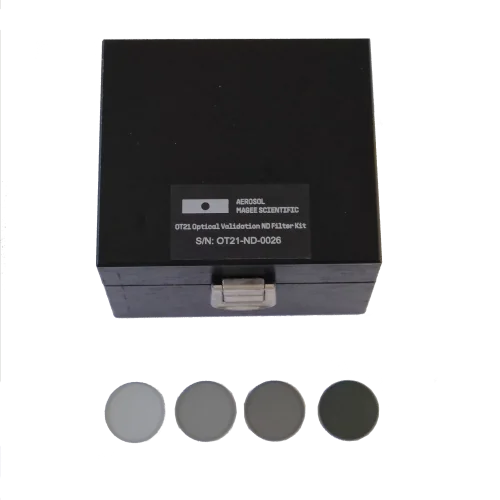
The analysis is non-contact, non-contaminating, and non-destructive. It may therefore be performed before other laboratory techniques are applied to the sample.  The analysis method requires no support gases or consumables. A neutral density photometric standard kit is available for verifying instrument calibration and validating the instrument response.

SOOTSCAN OT21

PRODUCT INFO

Information
Specifications
Documents
Publications
Accessories
SOOTSCAN OT21

APPLICATIONS

Mine ventilation optimization

Mine ventilation optimization

Learn how black carbon monitoring supports ventilation efficiency and cost savings in deep underground mining operations.
FIND OUT MORE

Urban maps of black carbon pollution

Urban maps of black carbon pollution

Compare personal black carbon exposure across transport modes and routes using mobile mapping in urban environments.
FIND OUT MORE

Global black carbon pollution

Global black carbon pollution

See how ultra-light aircraft measured black carbon globally to assess hotspots and long-range transport patterns.
FIND OUT MORE

Forest fire black carbon pollution

Forest fire black carbon pollution

Understand the emission factors and atmospheric impacts of biomass burning through both airborne and background measurements.
FIND OUT MORE

Marine vessel black carbon pollution

Marine vessel black carbon pollution

Uncover how ship emissions affect port air quality and how emission factors guide pollution control strategies.
FIND OUT MORE

Vertical profile of black carbon pollution

Vertical profile of black carbon pollution

Capture vertical profiles of black carbon to assess its role in radiative forcing and long-range transport in the atmosphere.
FIND OUT MORE

Vehicle emission factors

Vehicle emission factors

Compare stationary and mobile measurements of black carbon emission factors for real-world traffic pollution analysis.
FIND OUT MORE

Fossil fuel vs. biomass burning black carbon

Fossil fuel vs. biomass burning black carbon

Distinguish between fossil fuel and biomass burning sources of black carbon in urban and regional air quality studies.
FIND OUT MORE

Studies of carbonaceous aerosols with CASS and ACSM

Studies of carbonaceous aerosols with CASS and ACSM

Reveal detailed OM/OC and TC/EC/BC insights in real time by combining CASS and ACSM instruments.
FIND OUT MORE

Real-time wildfire smoke monitoring

Real-time wildfire smoke monitoring

Track real-time black and brown carbon from wildfires with the portable AE43 for emergency response and public health protection.
FIND OUT MORE

Off-grid black carbon monitoring

Off-grid black carbon monitoring

Monitor black carbon in remote locations with the solar-powered AE43, offering continuous data even without grid power.
FIND OUT MORE

Mobile measurement of black carbon

Mobile measurement of black carbon

Map black and brown carbon pollution on the move with the AE43 – ideal for urban, rural, or emergency air quality assessments.
FIND OUT MORE

EC/OC- photo-ms ambient aerosol filter pad analyzer

EC/OC- photo-ms ambient aerosol filter pad analyzer

Analyze quartz fiber filters with combined EC/OC carbon analysis and molecular-level speciation using photo-ionization TOF-MS.
FIND OUT MORE

Advanced apportionment of carbonaceous aerosols

Advanced apportionment of carbonaceous aerosols

The advanced TC/BC(l) method can be used to study the influence of anthropogenic processes.
FIND OUT MORE

Airport black carbon emissions and their impact on nearby communities

Airport black carbon emissions and their impact on nearby communities

Airports, with their high traffic of jet engines and ground support equipment, are significant sources of black carbon emissions.
FIND OUT MORE

Black carbon health effects studies

Black carbon health effects studies

BC is a harmful pollutant with significant adverse effects on human health. The Aethalometer is a valuable tool in monitoring black carbon levels and aiding in health-related research.
FIND OUT MORE

FAQ

WHAT IS THE OT21 OPTICAL TRANSMISSOMETER USED FOR?

The OT21 is a filter-based instrument that measures black carbon (BC) by analyzing light attenuation through particulate-laden filters. It is particularly useful for estimating elemental carbon (EC) concentrations from archived filters, supporting air quality and climate studies.

HOW ACCURATE IS OT21 COMPARED TO THERMAL-OPTICAL EC METHODS?

OT21 measurements on both Teflon and Quartz filters show a strong correlation with EC values obtained via the IMPROVE_A TOR thermal-optical method. Deviations are typically very low, making OT21 a reliable tool for estimating elemental carbon.

CAN ARCHIVED FILTERS BE USED FOR OPTICAL EC ESTIMATION?

Yes. One of the key advantages of this method is the non-destructive use of archived PM2.5 filters. This allows researchers to retrospectively analyze elemental carbon (EC) trends without needing new samples. The EPA encourages state and local agencies to continue archiving filters, as they are valuable for expanding EC datasets and improving historical air quality assessments.

CAN OT21 BE USED FOR VEHICLE EMISSIONS ANALYSIS?

Yes. In the Hu-2011 study, OT21 was successfully used to measure black carbon emissions from light-duty vehicles. It provided consistent results across different fuels and vehicle types, demonstrating its applicability in transportation emissions research.

WHAT ARE THE ADVANTAGES OF USING OT21 FOR BC/EC ANALYSIS?

  • Non-destructive: Allows reuse of archived filters
  • Cost-effective: No need for new sampling infrastructure
  • Versatile: Applicable to both ambient air and vehicle emissions
  • Correlates well with elemental carbon from thermal-optical methods
  • Supports high spatial and temporal resolution in monitoring networks
HEADQUARTERS

Aerosol d.o.o.
Kamniška 39A
1000 Ljubljana
Slovenia, Europe
+386 1 4391 700

USA Office

Aerosol USA Corp.
10157 SW Barbur Blvd Suite 100C
Portland, OR 97219 USA
+1 510 646 1600